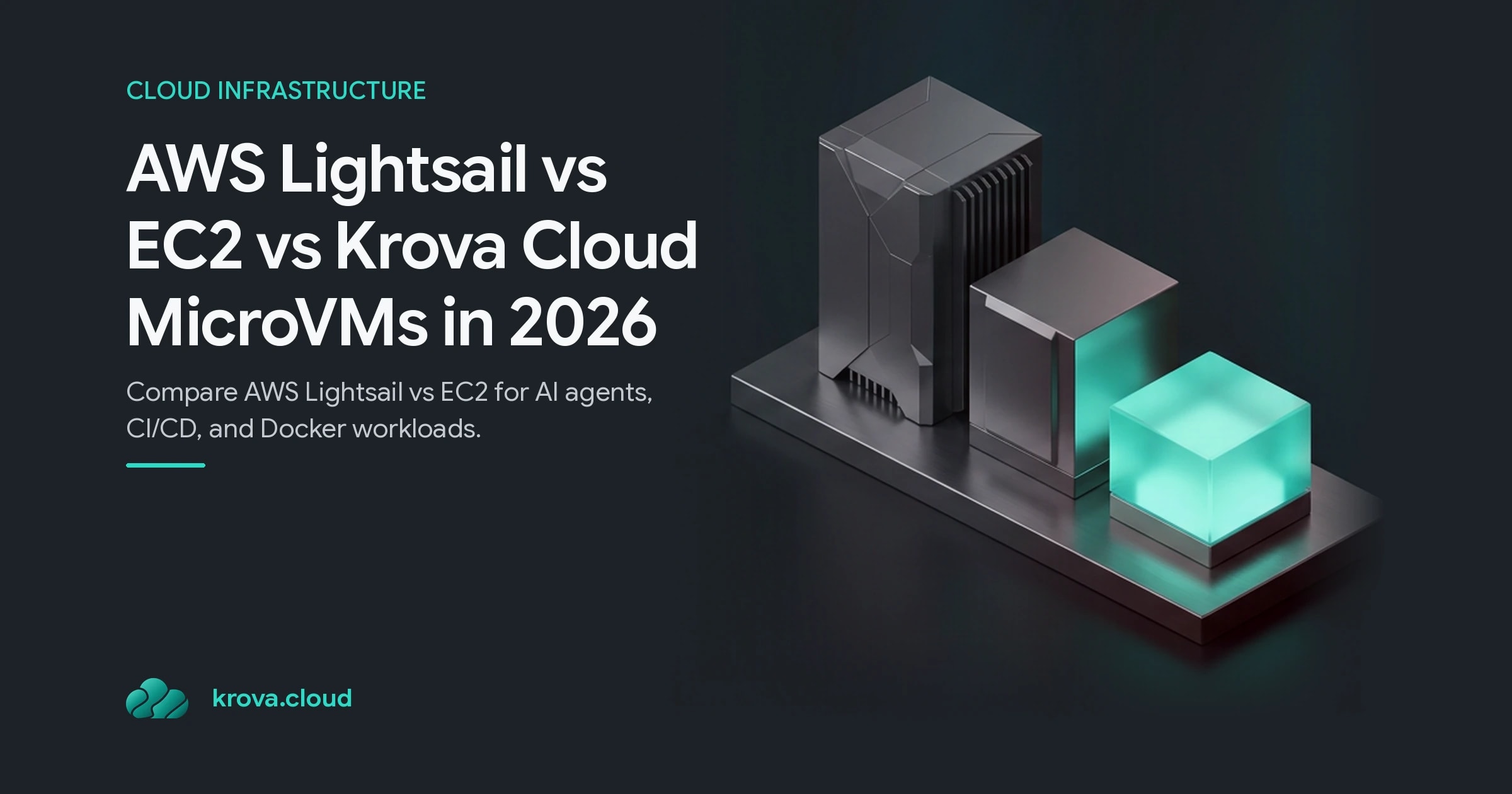
AWS Lightsail vs EC2 vs Krova Cloud MicroVMs in 2026
Compare AWS Lightsail vs EC2 for AI agents, CI/CD, and Docker workloads. See real costs, performance trade-offs, and when microVMs win over both platforms.
 DM
DMLast updated
Choosing between AWS Lightsail vs EC2 feels like picking between a toy and a jet engine, but the right choice depends entirely on what you're actually running. If you're spinning up AI agent sandboxes, ephemeral CI environments, or untrusted code in Docker containers, this decision determines whether you pay $20 a month or $2, and whether your workload even fits your security model.
TL;DR: In the aws lightsail vs ec2 debate, Lightsail is simpler and cheaper for predictable, low-complexity workloads; EC2 offers unlimited flexibility for scaling and managed services but demands more ops and billing vigilance. For AI agents and bursty sandboxes, per-minute microVMs like Krova Cloud Cubes cut costs substantially over both by eliminating idle-time waste and isolating each workload with its own kernel.
What Does AWS Lightsail vs EC2 Actually Mean?
AWS Lightsail is a managed VPS layer sitting on top of EC2, which is the core of any aws lightsail vs ec2 comparison. You pick from fixed monthly bundles (a 512 MB / 20 GB plan, a 2 vCPU / 4 GB plan, etc.), and you pay a flat fee whether your workload uses 5% or 95% of those resources. The tradeoff: you lose granular control over networking, security groups, and auto-scaling, but you gain simplicity.
EC2, by contrast, is AWS's raw compute service. You size instances precisely, configure every network detail, and pay per second for whatever runs. That flexibility comes with dozens of decisions: instance type, security group rules, VPC routing, Auto Scaling policies, and cost monitoring.
The core difference: Lightsail abstracts away complexity in exchange for less flexibility. EC2 trusts you to own every layer.
Neither is "better." But for AI agents, CI/CD, and untrusted code, the question matters because isolation, security, and cost all change depending on what you pick.
Managed Hosting vs Unmanaged: The Core Divide
The managed hosting vs unmanaged split is where this decision gets real.
Lightsail handles OS patching, firewall defaults, HTTPS certificates, and snapshots. When you launch an OpenClaw instance on Lightsail, AWS pre-configures Amazon Bedrock as the default AI model provider, and security controls like sandboxing and device pairing authentication come built in. You click "create," and it runs. No VPC. No security group debugging.
EC2 makes you own all of that. You provision an instance, configure security groups, manage firewall rules, set up IAM roles, and integrate logging yourself. If you want HTTPS, you provision and renew certificates. If you want isolated multi-tenant workloads, you design and monitor that isolation.
For a small AI agent or single-container deployment, Lightsail's overhead vanishes and you ship faster. For 50 microservices across Availability Zones with auto-scaling and complex network policies, EC2 is the only option.
The cost difference matters. Lightsail's flat $20/month plan means predictable billing. EC2's per-second model looks cheaper on paper. In practice, migrations to per-minute platforms often cut compute costs by 30% to 60% by eliminating idle-time waste.
AWS Lightsail 2026: Updated Security and AI Integration
Lightsail grew up in 2026. The addition of OpenClaw as a one-click blueprint marks a shift toward pre-baked, opinionated workloads. Instead of starting with a blank Linux instance, you deploy a full AI agent platform with browser automation, LLM task execution, and messaging integrations (Telegram, WhatsApp, Discord) all connected.
OpenClaw on Lightsail runs inside your AWS environment, giving you full control over infrastructure and API credentials, without the SaaS risk. Lightsail instances ship with sandboxing, device pairing authentication for browser access, automatic snapshots, and one-click HTTPS, no manual TLS configuration.
The catch: if your workload is bursty or runs sporadically (like a CI job or an AI job queue), you still pay the full $20/month even when idle. Lightsail's managed layer assumes steady-state uptime. It is not optimized for ephemeral workloads.
AWS EC2 2026: Flexibility Meets Complexity
EC2 remains the kitchen sink. Want to run a GPU-accelerated AI inference job for 10 minutes, then scale to zero? EC2 Spot Instances can do it cheaper than reserved capacity. Want a Kubernetes cluster with 100 nodes? EC2 is the foundation (usually wrapped in EKS to avoid overhead).
The 2026 reality: EC2 is less a choice and more a foundation, which reframes the whole aws lightsail vs ec2 comparison. Most new workloads use a managed layer on top (EKS, Lambda, or Lightsail) because the bare service is too open-ended. But when you need true customization, custom kernels, real-time resource control, or cost-aggressive infrastructure, EC2 remains the only option at scale.
The billing model is the most deceptive part of aws lightsail vs ec2. EC2 charges per second, which sounds cheaper than Lightsail's fixed monthly fee. A t3.medium instance (2 vCPU / 4 GB) runs about $0.0416/hour on-demand. That's $30/month if you run it 24/7. But in practice, the bill compounds when you forget to turn off dev environments, and auto-scaling mistakes can spike costs before you notice.
Performance and Cost Trade-Offs for AI Agent Sandboxes
For AI agents and untrusted code, isolation matters. Docker containers share a kernel, so a resource leak or security breach in one agent can reach others. Lightsail and EC2 run full VMs with separate kernels, which is safer. But they cost more and boot slower.
Firecracker microVMs split the difference: each workload gets its own isolated kernel in a per-VM sandbox, but they boot in seconds. That speed and isolation are why microVMs have become the standard for AI sandboxes, ephemeral CI environments, and any workload that needs to spawn and destroy rapidly.
The cost math for a bursty AI agent:
- Lightsail ($20/month): Fixed cost whether the agent runs 1 hour or 730 hours.
- EC2 on-demand (~$30/month at full utilization): Per-second billing, but still costs money even when idling.
- Krova Cloud Cubes (per-minute billing): Pay only when it runs. Bursty workloads cost far less.
For AI sandboxes spinning up dozens of agents per day, microVMs win on both cost and speed.
In the aws lightsail vs ec2 decision, Lightsail is the right pick if you're running a single, always-on application (a web app, a Telegram bot, a small API). EC2 is the right pick if you need managed services, complex scaling, or compliance features Lightsail doesn't expose. Per-minute platforms are the right pick if you're running ephemeral workloads, developing locally before moving to production, or running untrusted code in isolated environments.
FAQ
What Is OpenClaw on Lightsail?
OpenClaw is an open-source, self-hosted AI agent platform that runs directly on your infrastructure, connecting to messaging apps like Telegram and WhatsApp. AWS offers it as a one-click blueprint on Lightsail, pre-configured with Amazon Bedrock as the default AI model provider, with sandboxing and device pairing authentication built in.
How Does AWS Lightsail vs EC2 Pricing Compare for AI Workloads?
On pricing, aws lightsail vs ec2 breaks down like this: Lightsail costs $20/month for a 2 vCPU / 4 GB instance whether it runs constantly or sporadically, making billing predictable but wasteful for bursty jobs. EC2's per-second on-demand model charges roughly $30/month at full utilization, but includes auto-scaling and managed services. Per-minute platforms cut costs substantially on ephemeral workloads by billing only for active runtime.
Is microVM Isolation Secure Enough for Untrusted Code?
Yes. MicroVMs give each workload its own isolated kernel, making them stronger than shared-kernel containers for running untrusted or multi-tenant code. This is why AWS Lambda and Fargate use microVMs for isolation-critical workloads.
Should I Run OpenClaw on Lightsail or EC2?
Lightsail is easier (one-click deploy, pre-configured security) and cheaper for always-on agents. EC2 is better if you need auto-scaling, connected managed services, or complex multi-region deployments. For development or testing OpenClaw before committing to either, a per-minute microVM sandbox is fastest to spin up and cheapest to iterate on.
Past Lightsail vs EC2: try microVMs
Compare the same workload on Krova: launch a Firecracker microVM in seconds, without sizing an instance family or managing a cluster.