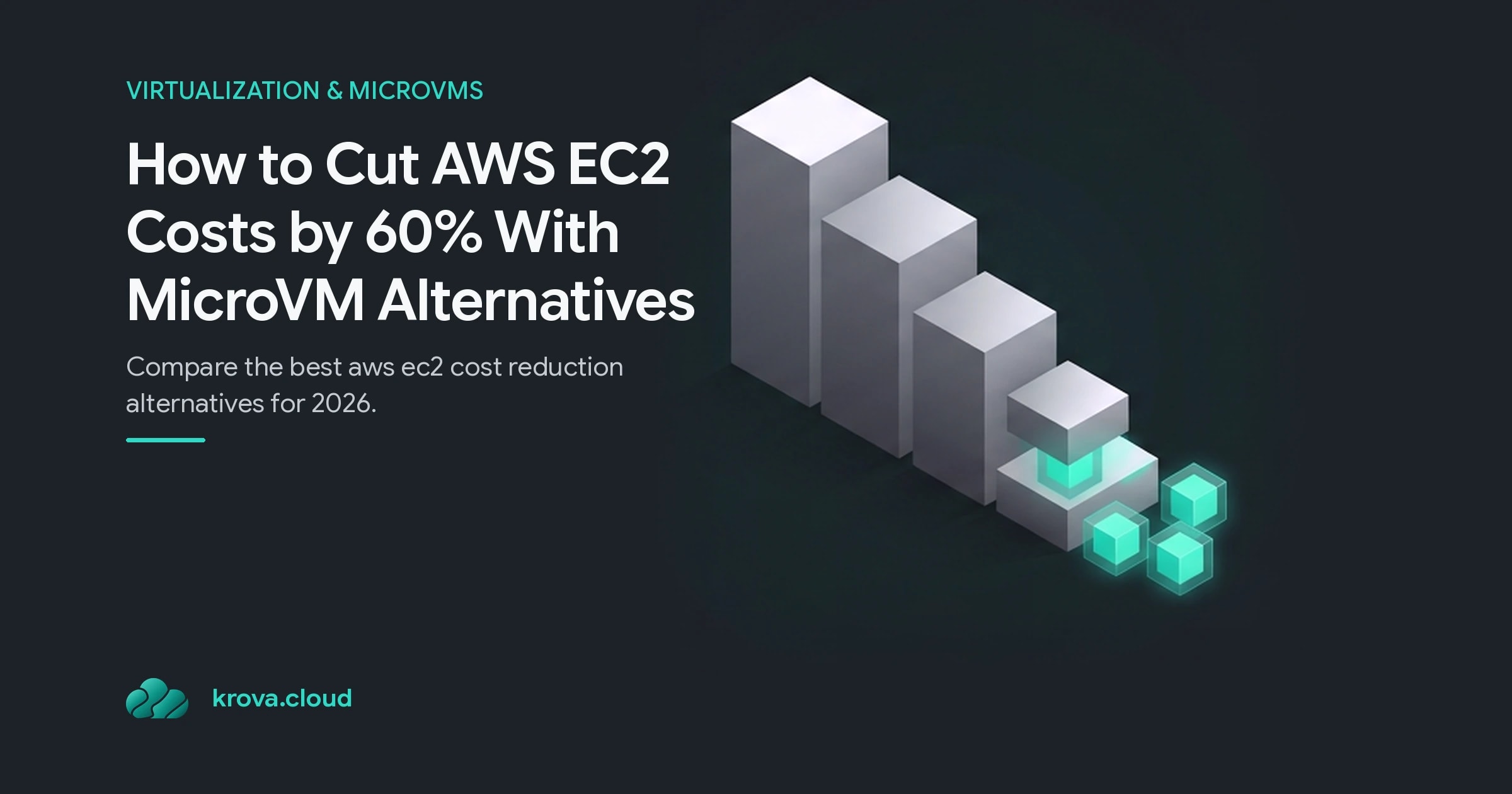
How to Cut AWS EC2 Costs by 60% With MicroVM Alternatives
Compare the best aws ec2 cost reduction alternatives for 2026. See how microVMs and transparent pricing cut your cloud bill by up to 60% without lock-in.
 DM
DMLast updated
One tech startup moved a workload off EC2 to DigitalOcean and cut its compute costs by 30% overnight, exploring AWS EC2 cost reduction alternatives that offered clearer pricing. If you've ever stared at an AWS invoice trying to figure out why a few small instances cost more than your rent, you already know the problem: EC2 pricing is opaque, and that opacity is expensive.
One shift matters here. The aws ec2 cost reduction alternatives available in 2026 are no longer a downgrade. Some of these aws ec2 cost reduction alternatives, especially microVM-based platforms, can slash your compute bill by 50 to 60% while giving you the isolation and startup speed EC2 was never designed for.
Let's break down where your money is actually going, and how to stop the bleeding.
Why Your EC2 Bill Keeps Climbing (and What AWS EC2 Cost Reduction Alternatives Can Do)
EC2 charges you for a lot of things you don't think about until the invoice arrives: idle capacity, over-provisioned instance sizes, data transfer, and the fixed, opaque rate card that never seems to move in your favor.
Most teams over-provision on purpose. You pick a bigger instance "to be safe," then run it at 15% utilization for months. That safety margin is pure waste, and at scale it's the single biggest reason your cloud bill balloons.
The usual AWS-native fixes help, but each comes with a catch:
- Spot instances can cut costs dramatically by selling you spare capacity, but AWS can reclaim them with a two-minute warning. Great for batch jobs, risky for anything stateful.
- Reserved instances and savings plans lower costs for predictable workloads, but they lock you into 1 to 3 year commitments and guesswork about future demand.
- Auto-scaling adjusts capacity to match demand, which helps, but it doesn't fix the underlying per-hour rate you're paying.
The core issue isn't that you're using EC2 wrong. It's that a fixed, opaque rate card gives you almost no say in the price. That's exactly the gap microVM and open-market aws ec2 cost reduction alternatives were built to close.
What Are AWS EC2 Cost Reduction Alternatives?
An AWS EC2 cost reduction alternative is any compute platform or pricing model that delivers the same virtual servers for meaningfully less money, either through transparent flat pricing, an open-market auction, or lighter-weight virtualization like microVMs. In other words, aws ec2 cost reduction alternatives compete on precisely the pricing control EC2 denies you.
They generally fall into three buckets:
- Hyperscalers that match EC2 feature-for-feature. Google Cloud Platform and Microsoft Azure compete directly, and sometimes win on specific instance types or committed-use discounts. Useful if you need a full service catalog, less useful if you want simplicity.
- Developer-friendly flat-rate platforms. DigitalOcean and similar providers offer predictable, published pricing and a single unified interface for servers, networking, and databases. Teams pick these to escape the sprawl of AWS's service catalog, and it's a solid aws lightsail alternative when you've outgrown Lightsail but don't want EC2's complexity.
- Open-market and microVM platforms. Rackspace Spot, for example, uses an open-market auction instead of a fixed rate card, letting the price float down toward real supply and demand. MicroVM hosts push cost-efficiency further by packing more isolated workloads onto the same hardware.
The right ec2 alternative depends entirely on your workload. But if your goal is cheap cloud compute with strong isolation, microVMs are among the aws ec2 cost reduction alternatives that deserve a serious look.
How MicroVMs Deliver Cheap Cloud Compute Without the EC2 Tax
A microVM is a lightweight virtual machine that boots in a fraction of the time of a traditional EC2 instance and consumes far fewer resources, while still giving each workload its own isolated kernel. This is what makes microVMs stand out among aws ec2 cost reduction alternatives.
That matters for two reasons.
First, isolation without the overhead. Containers are cheap but share a kernel, which is a security concern for multi-tenant or AI/ML workloads running untrusted code. Full VMs are isolated but heavy. MicroVMs sit in the sweet spot: VM-grade isolation with near-container startup speed and density.
Second, you pay for what you actually use. Because microVMs are so lightweight, providers can offer far more granular, cheaper pricing than a full EC2 instance. Instead of renting a whole oversized server, you rent a tightly sized slice that spins up in milliseconds and spins down when idle.
Say you run an AI inference service that gets bursty traffic. On EC2 you'd keep a large instance warm to handle spikes, paying for idle time all night. With a microVM platform, you spin up isolated compute per request or per burst, then release it. That utilization difference is where the 50 to 60% savings comes from.
For developers and AI/ML builders who need secure, isolated compute that only costs money while it's working, microVMs are the most direct of the aws ec2 cost reduction alternatives for reducing your cloud bill.
The Trade-Offs: Where MicroVM and EC2 Alternatives Fall Short
No alternative is free lunch, and pretending otherwise is how teams get burned. Here's what to weigh honestly before you pick among the aws ec2 cost reduction alternatives.
Ecosystem depth. AWS has a service for everything. If your app leans heavily on a dozen managed AWS services, a leaner platform means rebuilding or replacing pieces. Budget for that migration time.
Spot-style interruptions. Open-market and spot pricing win on cost but can reclaim capacity on short notice. If a workload can't tolerate a two-minute eviction, keep it on stable, flat-rate compute instead.
Tooling maturity. Some newer microVM platforms don't yet match AWS's breadth of monitoring, IAM, and compliance certifications. Check for the specific certifications your industry requires before you commit.
Cost visibility, ironically. Multi-cloud setups can get harder to track. Tools like CloudZero exist specifically because teams lose sight of costs across AWS, GCP, and Azure. If you split workloads, invest in per-unit cost visibility from day one.
Most people get this wrong: they move everything at once, hit a snag, and blame the alternative. The teams that actually cut their bill with aws ec2 cost reduction alternatives move one non-critical workload first, measure the real savings, then expand.
How to Migrate and Reduce Your Cloud Bill This Week
You don't need a six-month migration project to start saving. Here's a practical order of operations for testing aws ec2 cost reduction alternatives:
- Find your worst-utilized instances. Pull utilization data and flag anything running under 20%. These are your prime candidates.
- Pick one stateless, non-critical workload. A background job, a dev environment, or a bursty inference endpoint is ideal for a first move.
- Deploy it on a microVM or flat-rate ec2 alternative. Measure boot time, performance, and the actual bill after a full week.
- Compare like-for-like. Include data transfer and idle time, not just the hourly sticker price. This is where aws ec2 cost reduction alternatives usually pull ahead.
- Expand based on real numbers. Once you've proven a 30 to 60% saving on one workload, roll the pattern out to the next.
Start small, measure everything, and let the savings justify the next move.
FAQ
What is the cheapest alternative to AWS EC2 in 2026? It depends on workload, but among aws ec2 cost reduction alternatives, microVM platforms and open-market providers like Rackspace Spot typically beat EC2 on price because you pay closer to real utilization instead of a fixed rate card. For steady workloads, DigitalOcean's flat pricing is often cheaper and easier to predict.
Can microVMs carry production and AI workloads safely? Yes. MicroVMs give each workload its own isolated kernel, so they're stronger than shared-kernel containers for running untrusted or multi-tenant code, while still booting fast enough for bursty AI/ML traffic. That security profile is why they lead most lists of aws ec2 cost reduction alternatives.
Is there a good AWS Lightsail alternative for small projects? DigitalOcean and microVM-based hosts are strong Lightsail alternatives when you want predictable pricing and a simpler interface without the complexity of the full EC2 service catalog.
What does switching off EC2 actually save? Real-world migrations off EC2 have cut compute costs by around 30%, and aws ec2 cost reduction alternatives that eliminate idle-time waste can reach 50 to 60% on the right workloads. Measure one workload first to get your own number.
Run microVMs at a fraction of EC2 costs
Krova spins up Firecracker microVMs in seconds, slashing overhead without the EC2 bill or Kubernetes complexity.