Firecracker MicroVMs Explained: Architecture for Developers
Firecracker microVM explained for developers: how it boots in milliseconds, its KVM-based architecture, and where it beats containers and traditional VMs.
 RB
RBLast updated
If you are running multi-tenant code and relying on containers alone for isolation, you are trusting a shared kernel to keep tenants apart. That is exactly the problem Firecracker was built to fix. Here's firecracker microVM explained for people who actually ship: what it is, how it works, and when it's the right call. Consider this your practical guide without the marketing gloss.
Amazon Web Services created Firecracker to run services like AWS Lambda, where each customer function needs strong isolation but you cannot afford the seconds-long boot times of a traditional virtual machine. The result is a microVM that boots in milliseconds and carries almost none of the fat you expect from full virtualization. For measured numbers behind these mechanics, our Firecracker microVM benchmarks put boot times, density and cold starts on the record.
What Is a Firecracker MicroVM? Explained in Plain English
A Firecracker microVM is a lightweight virtual machine that gives you hardware-level isolation with minimal overhead. Each microVM runs its own guest Linux kernel, fully separate from every other microVM and from the host. That is the core of firecracker microvm explained in one sentence.
Think of it as the security of a real VM with the speed and resource efficiency of a container. You get the hardware boundary of virtualization without paying the usual weight tax of a full VM.
Firecracker is open source and purpose-built for secure, multi-tenant container and function-based services. It runs as a virtual machine monitor (VMM) in user space, and it deliberately keeps a minimal device model. There is no emulated BIOS, no unnecessary hardware, no legacy baggage. That stripped-down design is why a microVM can start so fast and use so little memory.
Say you run a platform where strangers upload code you have to execute. Containers share your host kernel, so one kernel exploit can be a bad day for everyone. A Firecracker microVM gives each of those workloads its own kernel and a KVM-enforced boundary instead.
How Firecracker Works: The MicroVM Architecture Under the Hood
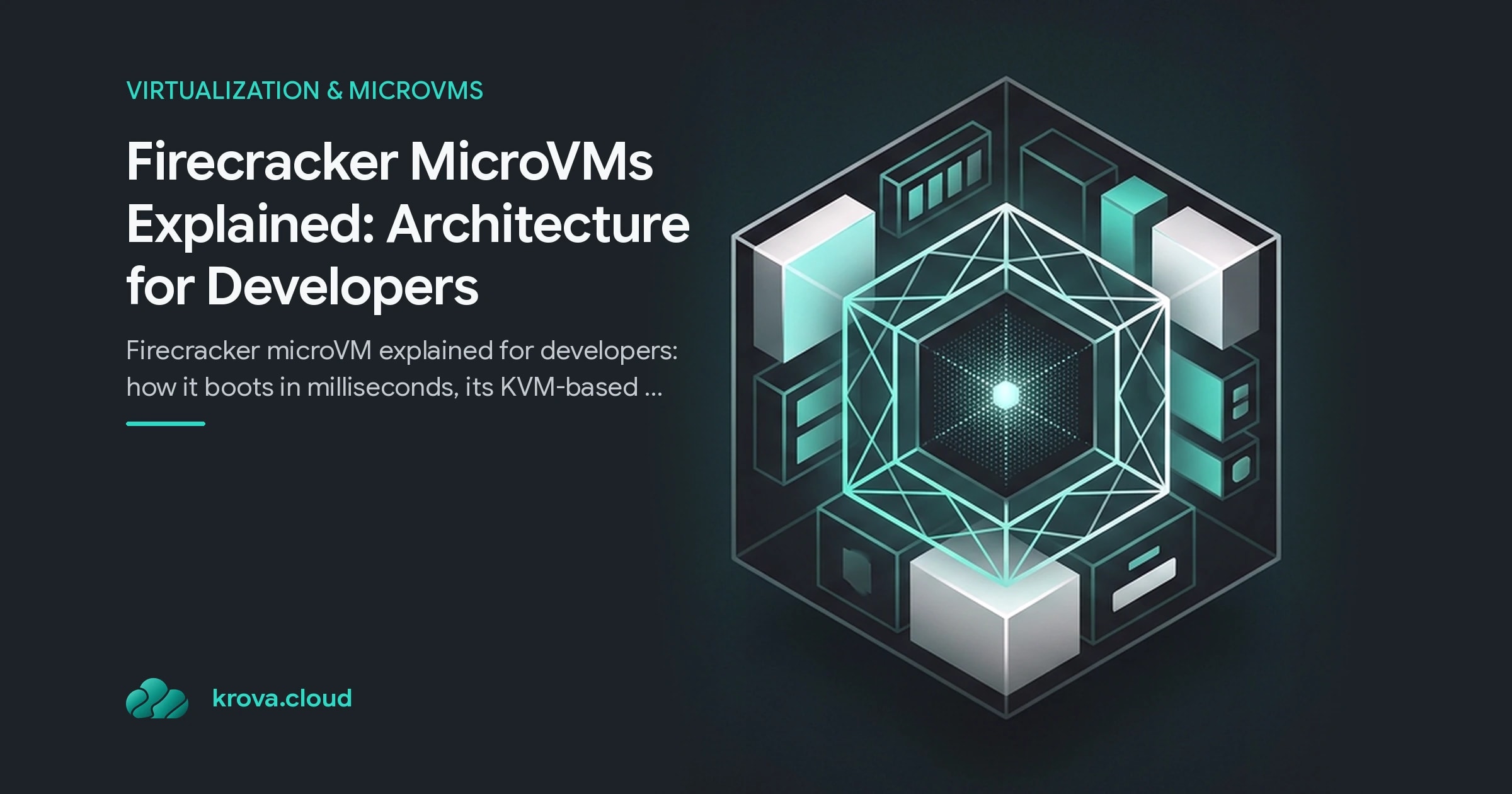
Here is how Firecracker works without the hand-waving, and it is the part of firecracker microvm explained that matters most for architects. Firecracker runs in user space and uses the Linux KVM (Kernel-based Virtual Machine) to create and run each microVM. KVM does the heavy lifting of hardware virtualization; Firecracker manages the lifecycle around it.
The microvm architecture centers on a few clean pieces:
- The VMM process: each Firecracker process manages one microVM and exposes a RESTful API endpoint for control.
- KVM: provides the underlying hardware virtualization that enforces isolation between microVMs.
- The Jailer: wraps each microVM in namespaces, cgroups, and seccomp filters so a compromised guest cannot reach the host.
- The API server: a simple REST interface to create, configure, start, and stop microVMs.
- A metadata service: lets you securely pass configuration into a running microVM.
Starting a microVM follows a predictable flow. The Firecracker process launches and exposes its API. You configure the microVM through API calls, setting vCPUs, memory, network interfaces, and block devices. You hand it a Linux kernel image and a root filesystem. Then Firecracker boots the guest.
Because the device model is intentionally tiny, there is very little to initialize. That minimalism is the whole trick: fewer moving parts means faster boots, a smaller attack surface, and lower memory per microVM. You configure everything through one API instead of wrestling with a sprawling hypervisor.
Why AWS Firecracker Open Source Beats Containers for Multi-Tenant Workloads
Containers are fast and cheap, but they all lean on the same host kernel. For a single team running trusted services, that is fine. For a platform running untrusted or mixed-tenant code, that shared kernel is a real risk. This is where firecracker microvm explained becomes a decision about security, not just speed.
The aws firecracker open source project closes that gap. Each microVM gets its own kernel and a hardware-enforced boundary, so a break-out in one tenant does not become a break-in for the rest. You get isolation closer to a full VM while keeping startup times and density closer to containers.
This is why Firecracker fits so well for:
- Serverless functions where every invocation needs a clean, isolated sandbox.
- AI and ML workloads running untrusted or user-submitted code and models.
- Ephemeral, multi-tenant jobs that spin up, do work, and disappear.
Cloud providers already lean on this. Oracle Cloud Infrastructure, for example, runs Firecracker on both bare metal and select VM shapes via nested virtualization, letting teams trade raw performance for operational convenience with predictable results. If your workload is short-lived, multi-tenant, and security-sensitive, Firecracker gives you a better isolation-to-speed ratio than plain containers.
The Trade-Offs and Mistakes Developers Make with Firecracker
Firecracker is not a drop-in replacement for Docker, and pretending it is will burn you. Here is the part of firecracker microvm explained where people get it wrong.
Mistake one: expecting a full hardware model. Firecracker's minimal device model is a feature, not a bug, but it means you do not get every emulated device a traditional hypervisor offers. If your workload needs exotic hardware passthrough, check compatibility first.
Mistake two: ignoring the KVM requirement. Firecracker needs KVM. On bare metal that is straightforward. On a cloud VM you often need nested virtualization support, and not every instance shape offers it. Plan your host layer before you plan your microVMs.
Mistake three: treating Firecracker as a full orchestrator. Firecracker manages individual microVMs through its API. It does not schedule, load balance, or handle service discovery on its own. You bring your own control plane or use a platform that has built one for you.
The honest trade-off: you take on more of the plumbing than you would with a managed container service, in exchange for real hardware isolation and millisecond boots. For the right workload that trade is worth it. For a small internal app with trusted code, containers are probably simpler.
How to Start Using Firecracker MicroVMs This Week
You do not need to rebuild your stack to get a feel for this. Start small and concrete:
- Confirm your host supports KVM. Use a bare-metal box or a cloud shape with nested virtualization enabled.
- Grab the open source project from the Firecracker GitHub repo and its official docs.
- Boot one microVM by hand. Provide a Linux kernel image and a root filesystem, then drive it with the REST API to set vCPUs, memory, and a network interface.
- Measure boot time and memory so you have real numbers for your workload instead of assumptions.
- Decide on a control plane. For production multi-tenancy, either build orchestration around the API or use a hosting platform that already runs Firecracker for you.
Boot one microVM by hand first; that single exercise teaches you more about the architecture than any diagram. Once you have seen a VM start in milliseconds, you will have firecracker microvm explained in a way no article can match, and you will know exactly where it fits in your stack.
FAQ
Is Firecracker the same as Docker? No. Docker runs containers that share the host kernel. Firecracker runs microVMs, each with its own guest kernel and hardware-level isolation via KVM. Some teams even run containers inside Firecracker microVMs to get both worlds.
Do I need bare metal to run Firecracker? Not necessarily. Firecracker requires KVM, which runs natively on bare metal. On cloud VMs you need nested virtualization support, which only some instance shapes offer, so check before you commit.
How fast do Firecracker microVMs start? They boot in milliseconds thanks to a minimal device model and no legacy hardware emulation. That startup speed is the main reason AWS built Firecracker to power services like Lambda, and it is a big part of why firecracker microvm explained keeps coming up in serverless discussions.
Is Firecracker free and open source? Yes. Firecracker is an open source virtualization project developed at AWS and maintained on GitHub, purpose-built for secure, multi-tenant serverless and function-based workloads. That is firecracker microvm explained at the licensing level: free to use and open to inspect.
Run Firecracker microVMs instantly
Understand the architecture, then deploy it: spin up isolated VMs in seconds on Krova, no cluster management needed.