Firecracker vs KVM: Virtualization Performance
Stop comparing apples to virtualization stacks. Learn how Firecracker vs KVM actually works, why microVMs boot in 125ms, and how to isolate untrusted code.
 DM
DMLast updated
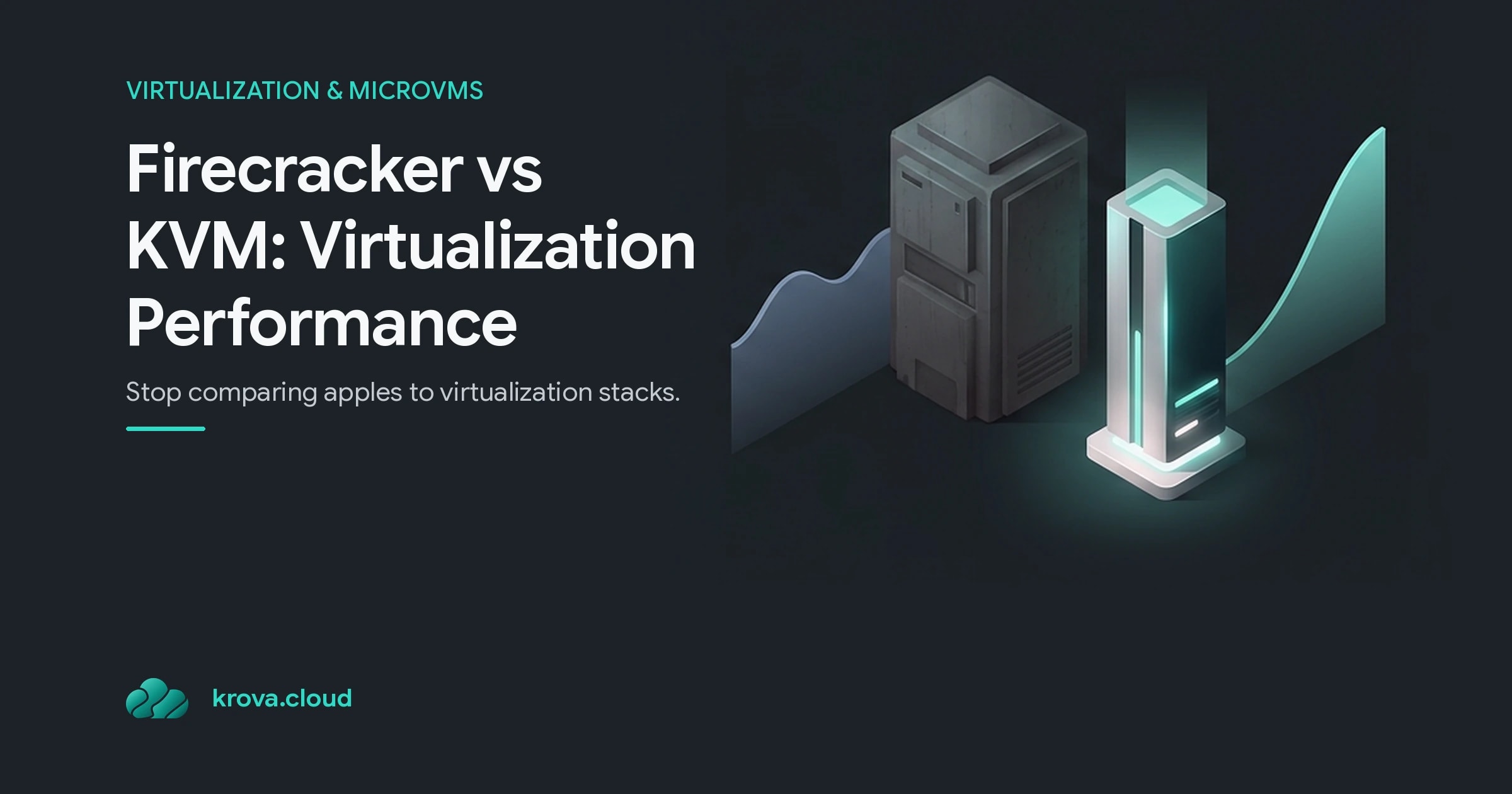
Developers often confuse the layers of modern cloud infrastructure. When you evaluate firecracker vs kvm, you are not actually looking at competing tools. You are looking at a stack. KVM provides the raw hardware acceleration. Firecracker is the lightweight manager that sits on top to turn that power into fast microVMs.
If you run AI-agent sandboxes, untrusted code, or massive serverless platforms, containers are no longer secure enough. You need the hardware boundary of a virtual machine without the crushing memory overhead of a traditional hypervisor. This is exactly the problem modern cloud virtualization solves.
TL;DR:
- KVM is the hypervisor. It handles CPU and memory virtualization directly at the kernel level.
- Firecracker controls KVM. It acts as a virtual machine monitor (VMM) to launch stripped-down virtual environments.
- Boot times drop to milliseconds. By dropping legacy hardware support, Firecracker boots much faster than full emulators.
- Memory overhead is tiny. Each microVM adds less than 5 MiB of overhead, letting you run thousands on a single host.
Understanding Firecracker vs KVM: The Virtualization Stack
The fundamental misconception in the firecracker vs kvm debate is treating them as alternatives. They work together.
When evaluating firecracker vs kvm, it is important to understand that Linux Kernel-based Virtual Machine (KVM) is the actual hypervisor. It runs natively on the host machine and uses hardware virtualization extensions like Intel VT-x or AMD-V. KVM isolates CPU and memory at the hardware level, but it cannot run a virtual machine entirely on its own. It needs a userspace program to configure the guest memory, emulate hardware devices, and manage the execution.
Firecracker is that userspace program. Built by AWS, Firecracker is a purpose-built VMM designed specifically for serverless computing and ephemeral workloads.
Firecracker is not a hypervisor, it is a process that controls KVM.
Unlike traditional VMMs such as QEMU that emulate full motherboards, USB controllers, and PCI buses, Firecracker provides a minimal device model. It includes only what a modern cloud workload actually needs, like VirtIO-Net for networking and VirtIO-Block for storage. This architectural minimalism is what creates a high-performance kvm microvm.
Performance and Speed: Why MicroVMs Scale
Traditional virtual machines are heavy. They spend seconds discovering emulated hardware during boot. Firecracker eliminates this discovery phase completely.
A Firecracker microVM boots in milliseconds. The memory overhead per instance sits below 5 MiB. This tiny footprint is the whole point, as it allows you to pack thousands of microVMs onto a single physical server.
Density is where Firecracker heavily outpaces traditional full-featured VMMs. In published performance analyses, researchers found that Firecracker scales remarkably well under high concurrency, drastically outperforming QEMU's microVM implementation when launching multiple environments in parallel.
If you need to spin up thousands of isolated environments per hour, Firecracker is the obvious choice.
Shutdown performance also matters for ephemeral workloads. Firecracker tears microVMs down quickly and predictably. When your workloads constantly start and stop, fast shutdown prevents your host from choking on stale processes.
Real-World Use Cases for Cloud Virtualization
Containers share the host kernel. If you run a platform where external users upload code, a single kernel exploit can leak across tenants. This is why platforms running untrusted code rely on hardware-level isolation.
Because Firecracker gives every workload its own guest Linux kernel, it creates a true hardware boundary. This isolation model is ideal for:
- AI and code-execution sandboxes: LLM agents that write and execute arbitrary Python scripts need strict boundaries.
- Ephemeral CI/CD pipelines: Short-lived build environments that require complete filesystem separation.
- Serverless functions: Functions that live for milliseconds but require strong tenant isolation.
- Self-hosted dev environments: Developer workspaces that need root access without compromising the underlying host.
If you need to deploy this architecture without building the complex networking yourself, Krova Cloud Cubes simplify the firecracker vs kvm debate by running isolated Firecracker microVMs for you. Every Cube gets its own kernel inside a per-Cube jailer sandbox. They boot rapidly and are unlisted from the internet until you explicitly open ports. Because Krova operates its own hypervisor stack, the compute is billed strictly by the minute with no overselling.
Trade-Offs You Need to Know Before Deploying
Firecracker's minimalism is its biggest advantage and its hardest limit.
The moment your workload requires something outside Firecracker's supported devices, you will hit a wall. There is no GPU passthrough. There is no support for legacy hardware, cross-architecture emulation, or graphics rendering.
If your workload requires specialized hardware or runs for months at a time, Firecracker is the wrong tool.
While a firecracker vs kvm comparison is common for microservices, for machine learning training, rendering tasks, or heavy desktop virtualization, QEMU is the practical choice. As noted in detailed evaluations of Firecracker vs QEMU: Which MicroVM Suits You? | Krova Cloud, developers often make the mistake of picking Firecracker for its speed and then fighting its strict hardware limits for months.
Match your tool to the workload shape. If your VMs live for seconds and run plain compute, use Firecracker. If they run for days and need GPU access, use QEMU.
FAQ
Is Firecracker a Replacement for KVM?
No. Firecracker relies entirely on KVM to function. KVM provides the hardware virtualization layer in the Linux kernel, while Firecracker sits in userspace and tells KVM how to configure the virtual machine.
Which Virtualization Setup Is Better for GPU Workloads?
QEMU running on KVM is better for GPU workloads. Firecracker intentionally omits PCI buses and hardware passthrough capabilities to keep its codebase small and fast, making it incapable of running heavy graphics or ML training tasks.
Are Docker Containers Faster Than a Firecracker microVM?
Docker containers start slightly faster and use slightly less memory than Firecracker. However, containers share the host kernel, making them vulnerable to cross-tenant exploits. Firecracker adds minimal overhead in exchange for true hardware-level security.
Experience Firecracker performance
Spin up a Firecracker microVM on Krova in seconds, with no Kubernetes clusters to babysit.