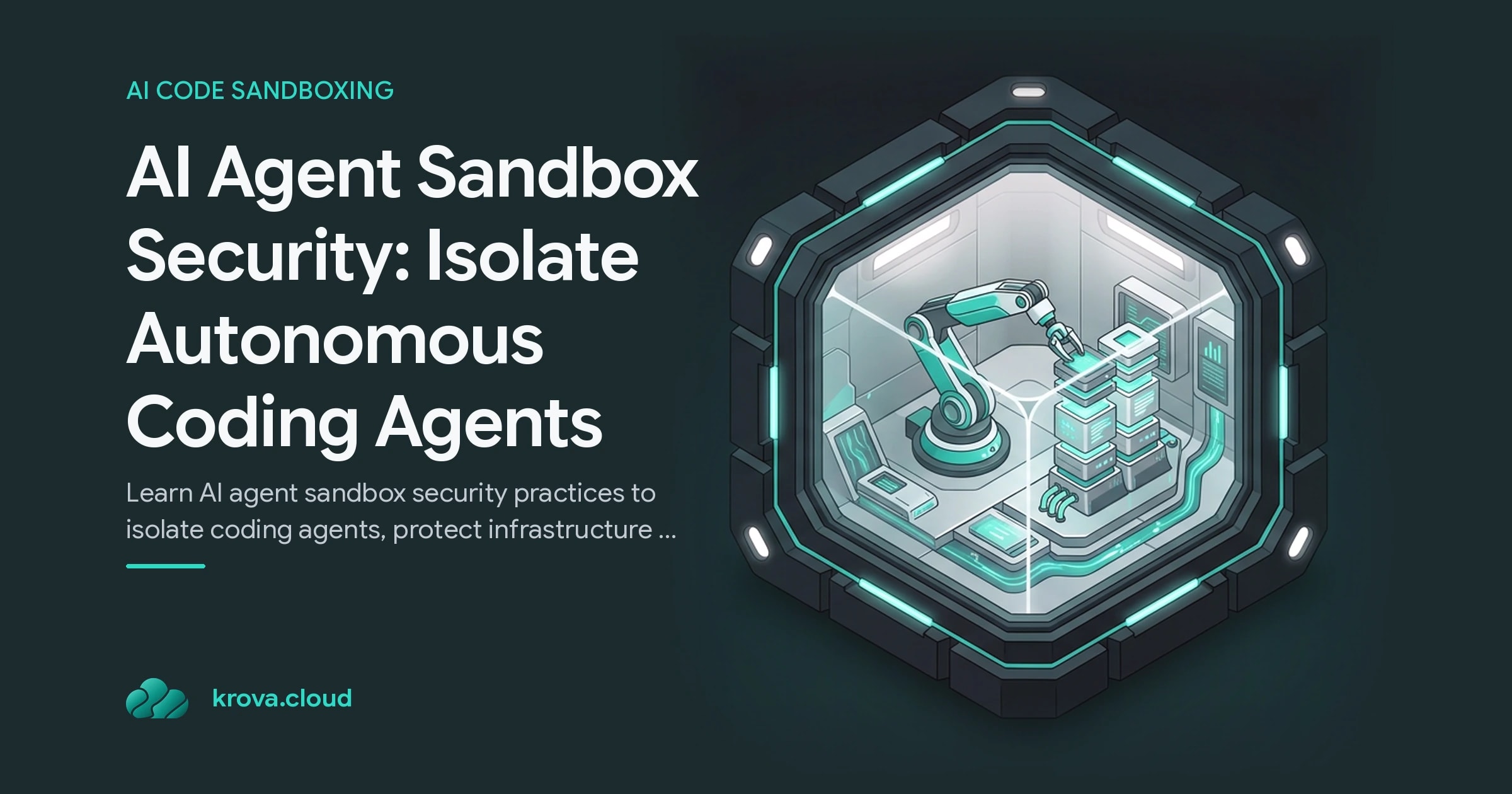
AI Agent Sandbox Security: Isolate Autonomous Coding Agents
Learn AI agent sandbox security practices to isolate coding agents, protect infrastructure, and run untrusted code with safer execution boundaries.
 RB
RBLast updated
AI agent sandbox security is becoming an important part of running autonomous coding tools in real development workflows. An agent that can write files, execute commands, or call APIs has moved past generating text. It is performing actions that can affect real systems.
The risk comes from giving an AI agent more access than it needs. A sandbox creates a controlled boundary where untrusted code can run without directly reaching production systems, private data, or the host machine.
TL;DR:
- AI agents should run inside isolated environments because generated code and actions need containment.
- Strong sandbox designs combine isolation, least privilege, resource limits, network controls, and monitoring.
- MicroVMs and other stronger isolation methods can help protect higher-risk workloads.
- Start with one workflow, move it into an isolated runtime, and adjust permissions based on real usage.
Why AI Agent Sandbox Security Matters For Modern Development
AI coding agents change the security model because they do more than suggest code. They can run commands, modify files, interact with services, and complete multi-step tasks on behalf of users.
Research on AI agent security highlights that agents introduce new risks because they can use tools and interact with external environments. You can read the broader security discussion in the Security of AI Agents research paper.
The core benefit of isolated execution is reducing the impact when generated code behaves unexpectedly.
For example, an AI agent might create a deployment script or run a dependency installation step. Inside a sandbox, those actions are contained within the isolated environment. Without isolation, the same actions may have access to systems or data they should not reach.
What Is AI Agent Sandbox Security And How Does It Work?
An AI sandbox is an isolated execution environment designed to run AI-generated code and agent actions with restricted access to system resources. It creates boundaries between what an AI agent can attempt and what infrastructure it is allowed to affect.
A secure sandbox treats agent-generated code as untrusted by default.
A practical sandbox usually controls several areas:
- Filesystem access: The agent receives only the files required for the task.
- Network access: Outbound connections are restricted to reduce unwanted data transfers.
- Compute resources: CPU, memory, and execution time can be limited to prevent runaway workloads.
- Permissions: Secrets and credentials are scoped instead of exposed broadly.
- Observability: Commands, tool calls, and activity logs provide a record of what happened.
Standard containers can help, but they are not always the strongest choice for untrusted agent workloads. Containers commonly share the host kernel, while approaches such as microVMs create a separate isolation boundary.
For teams building secure AI execution systems, the right approach depends on the risk. A local experiment may need less isolation than a system running unknown code from multiple users.
(Image: diagram showing an AI agent between a control layer and isolated execution environments, alt: 'Secure AI agent architecture with isolated workloads')
Key Isolation Layers For Secure AI Execution
Building safer agent infrastructure requires multiple controls working together. No single feature replaces a complete security model.
The strongest AI coding agent isolation setups combine boundaries, permission controls, and visibility.
MicroVMs For Stronger Workload Separation
MicroVM technology provides a stronger isolation boundary than ordinary containers in many high-risk scenarios by giving workloads a lightweight virtual machine environment. Sources covering AI sandbox strategies commonly highlight technologies such as Firecracker, Kata Containers, and gVisor as approaches used for isolated execution.
The right isolation method depends on the workload. Some teams may use containers with additional controls, while others may require stronger separation through microVM-based environments.
Network And Secret Controls
A sandbox should not receive every credential just because an agent might need it later. Mount only the project data required for the task and keep sensitive credentials outside the execution environment whenever possible.
Default-deny network policies are another important layer. Allowing only required endpoints reduces the chance of unwanted data transfers and limits dependency-related risks.
Logging And Review
Isolation answers where code runs. Logging answers what happened.
Track agent requests, tool calls, commands, and outputs so developers can investigate unexpected behavior. Secure AI execution is easier to maintain when important actions have a record.
Common Sandbox Mistakes And How To Avoid Them
Many teams understand that agents need isolation but still make design choices that weaken the boundary.
A sandbox is only effective when security controls are applied consistently.
Mistake 1: Assuming Any Container Is A Security Boundary
Containers are useful for packaging applications, but they are not always designed for hostile code. If your threat model includes malicious or unknown code, stronger isolation may be necessary.
Mistake 2: Removing All Persistence
Security does not require destroying all state after every run. A better approach is scoped persistence, where an agent can keep useful artifacts without accessing unrelated systems.
Mistake 3: Ignoring Resource Limits
An agent stuck in a loop can consume unexpected compute resources. Timeouts, memory limits, and CPU caps should exist before workloads reach production.
Teams should also avoid building a sandbox that developers cannot use effectively. Too many restrictions can encourage unsafe workarounds. The goal is controlled access with clear boundaries.
Different approaches, including container-based sandboxes, managed execution services, and microVM infrastructure, involve different trade-offs depending on operational needs.
How To Start Building Safer Agent Infrastructure
You do not need to redesign every developer workflow at once. Start with the highest-risk agent task and build outward.
A practical path to safer agent isolation is moving one real workflow into an isolated environment and measuring what it actually needs.
A practical first rollout:
- Pick one AI agent workflow that currently runs directly on a laptop, server, or CI runner.
- Move execution into an isolated sandbox or microVM.
- Remove unnecessary filesystem access and credentials.
- Block outbound network access by default, then allow only required services.
- Add logs for commands, requests, and agent actions.
- Review the workflow after real usage and adjust permissions.
The goal is simple: let agents do useful work while keeping failures contained.
FAQ
What Is AI Agent Sandbox Security?
AI agent sandbox security is the practice of running autonomous AI workloads inside isolated environments that restrict access to systems, files, networks, and resources. It reduces the impact of unsafe or unexpected agent actions.
Why Do AI Coding Agents Need Isolation?
AI coding agents can execute commands, install dependencies, and modify files. Isolation helps prevent generated code from directly reaching sensitive infrastructure before it has been reviewed.
Are Containers Enough for AI Agent Sandbox Security?
Containers can help with application isolation, but they share the host kernel. For untrusted code, many teams consider stronger isolation methods such as microVM-based environments.
How Can I Improve Secure AI Execution for My Team?
Start by moving one agent workflow into an isolated environment, limiting permissions, adding resource controls, and logging important actions. Then expand the same pattern to additional workloads.
One agent, one kernel, zero shared surface
Each Cube is a Firecracker microVM with its own kernel and no public IP, so an agent that misbehaves is contained in a machine you can destroy mid-sentence.