How to Safely Run LLM Generated Code in Production
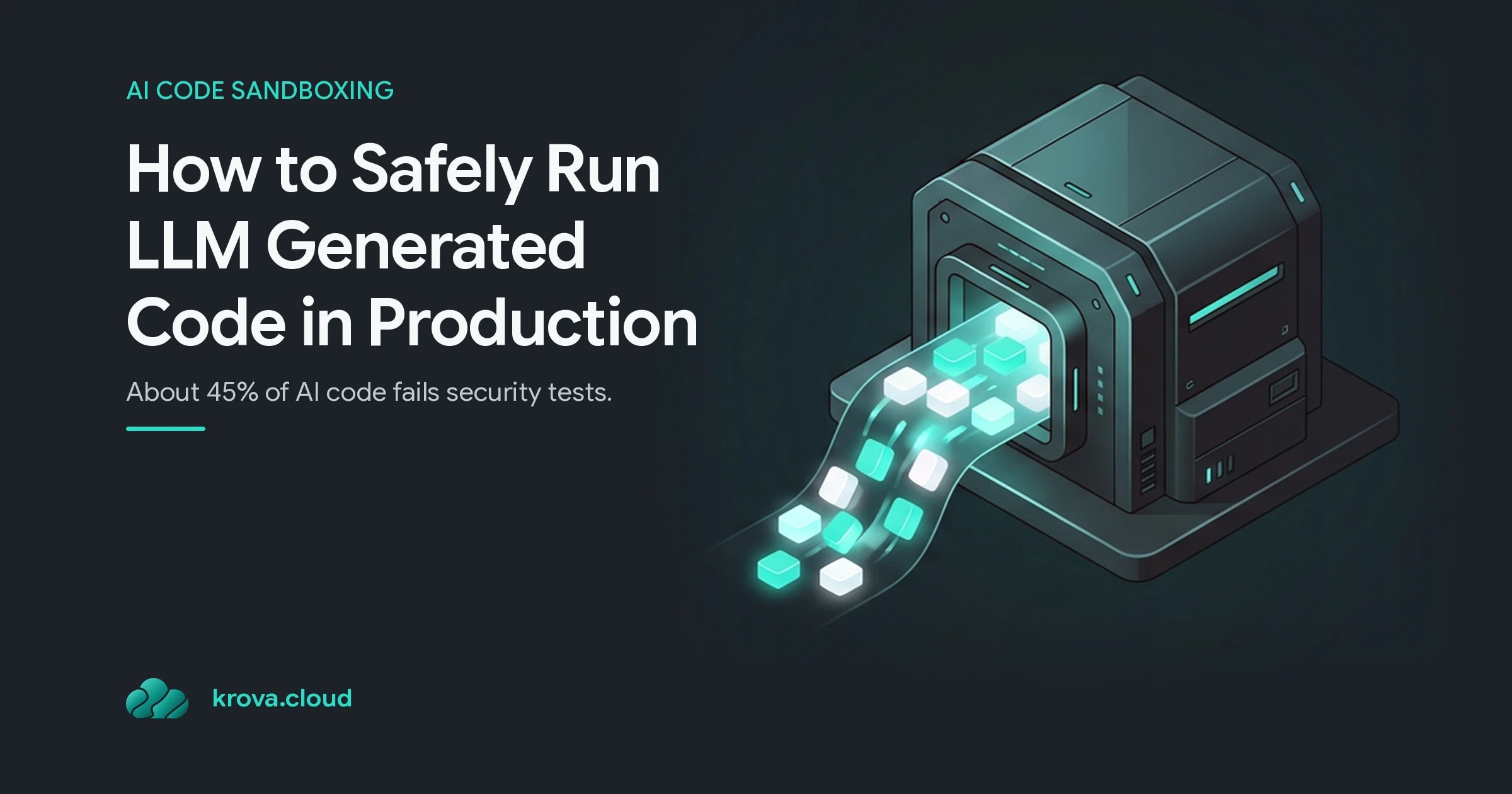
About 45% of AI code fails security tests. Learn how to securely run LLM generated code using microVMs, network limits, and isolated sandboxes.
 RB
RBLast updated
Generative AI is highly capable of generating code, but that output is inherently untrusted. Now picture what happens when you run LLM generated code with full access to your production network, your host filesystem, and your environment secrets. That is the gamble you take every time you let an AI coding agent execute output directly on your machine instead of in an isolated environment.
When an LLM writes code, producing syntactically correct text is only half the task. The system needs to execute that code to verify it works, close the loop, and iteratively refine the output. If you need to run LLM generated code safely at any kind of scale, you must treat that code as hostile by default.
Key takeaways:
- Never trust the host: Direct execution of AI code exposes your infrastructure to untested, potentially destructive commands.
- Containers are not enough: Docker shares a kernel with the host. MicroVMs provide hardware-level separation.
- Cap your resources: Agents caught in infinite loops will drain your cloud budget without hard CPU and memory limits.
- Default to offline: Block all outbound network access by default, allowlisting only the specific APIs a task requires.
What Does It Mean to Run LLM Generated Code Safely?
An AI coding agent is not a junior developer you can review before merging. It writes code, installs packages, and executes commands on its own, often faster than you can read them. You cannot inspect every action before it happens.
To run LLM generated code securely, you must place an architectural boundary between the code and your infrastructure. This practice is known as sandboxed code execution. Inside the boundary the code keeps every normal power: compute, output, the API calls you approved, a result to return. What it loses is reach. No path into the surrounding system, no files beyond its remit, no connections nobody authorised.
The goal is not building the strongest possible cage, but the right cage for the risk. Over-lock your environment and developers will route around it. Under-lock it and you are trusting unreviewed code with your entire blast radius. A proper sandbox shrinks that radius down to a disposable box.
This is not a niche concern. Demand for isolated code execution is exploding. Choosing to run LLM generated code directly in production software could lead to widespread system malfunctions if malicious code or hallucinations are executed. As multi-agent systems become the standard, secure transpilation and isolated execution environments are now a hard requirement.
Why Docker Containers Are Not a Security Boundary
The most common mistake engineering teams make is treating a Docker container as a secure sandbox. Containers are excellent for packaging and deployment, but they are built for convenience over strict security.
Because containers share the host kernel, a kernel exploit inside a shared container can reach the host or neighboring workloads. If your threat model assumes untrusted AI output, that shared surface is the exact weak point an attacker or a runaway script will exploit.
For truly untrusted input, you want microVM-level isolation, not just a Linux namespace.
MicroVMs give you hardware-level separation with startup times close to containers, making them perfect when you need to run LLM generated code. They boot a fresh, isolated kernel for every task. When the job finishes, the microVM is destroyed, ensuring no state bleeds between executions. If you are comparing Firecracker vs Docker: Which Is Best for Workload Isolation?, Firecracker microVMs win every time for untrusted workloads.
The Architecture of a Secure Code Sandbox
Moving an agent workflow into an ephemeral microVM requires three non-negotiable architectural controls.
First, you must lock down the network. Default to no outbound network access. Allowlist only the specific endpoints a job requires. This single rule stops a huge class of data exfiltration attempts and dependency poisoning risks.
Second, enforce resource ceilings at the hypervisor level whenever you run LLM generated code. AI agents that loop, retry, and spawn sub-agents can rack up compute charges incredibly fast. Without strict CPU, memory, and timeout limits, one agent stuck in a loop can spike your cloud bill overnight. Set the ceiling before you hand over the keys.
Third, log every action centrally. Secure execution is heavily dependent on visibility. You need to tie every request to a named user and record prompts, token usage, models, and tool calls. When a task fails, your audit logs will show exactly which permissions the agent actually needed.
Finally, handle persistence carefully. Killing all state for the sake of safety is a trap. If every run wipes state entirely, your agent forgets its work and re-installs dependencies from scratch. The answer is attaching scoped, persistent volumes to an otherwise isolated sandbox, keeping the agent useful without compromising the host.
Tools for Agentic Code Execution in 2026
You do not need to build a Firecracker orchestration platform from scratch to run LLM generated code effectively. Start with a managed platform and wire it in behind your existing workflow.
Several tools specialize in this exact problem:
- E2B: Provides long-running sandboxes tailored for AI agents, offering persistent state for multi-step tasks.
- Daytona: Offers tools to let developers safely run Python code using LangChain inside controlled environments.
- Bespoke Labs: Built an explicit code-executor to include error-free code in training pipelines, highly useful for agents and tool-use execution.
- Together AI: They provide an API called Together Code Interpreter that lets you securely execute code generated by LLMs and receive instant responses.
Start small. Pick one agent workflow that currently runs locally. Move it into an ephemeral microVM with no outbound network. Mount only the specific project directory and keep your provider API keys in a control plane so they never travel to the agent.
FAQ
Container or microVM: which boundary holds under agent code?
A container is a namespaced process running on somebody else's kernel, so one kernel exploit can reach the host and every tenant on it. A microVM boots its own kernel under hardware virtualization, and the same exploit's blast radius stops at that kernel, which is the boundary you want around untrusted, AI-generated code.
Does sandboxing mean the agent loses its work every run?
Yes. Good isolation pairs an ephemeral, locked-down runtime with scoped persistent volumes. The agent can save artifacts and resume across runs without ever touching the host filesystem or interacting with other sandboxed tenants.
How Do I Prevent Runaway LLM Agents from Spiking My Cloud Bill?
You must set hard CPU, memory, and timeout limits on the execution environment before the code runs. Pair these limits with per-minute billing platforms so that you only pay for the exact compute duration of the agent's task.
Sandbox LLM generated code on Krova
Spin up secure Firecracker microVMs in seconds to isolate AI-generated code without babysitting a Kubernetes cluster.