Lightsail vs DigitalOcean: Which Cloud Fits Developers?
Lightsail vs DigitalOcean compared for developers. See pricing models, isolation, flexibility, and when a simpler VPS alternative makes sense in 2026.
 RB
RBLast updated
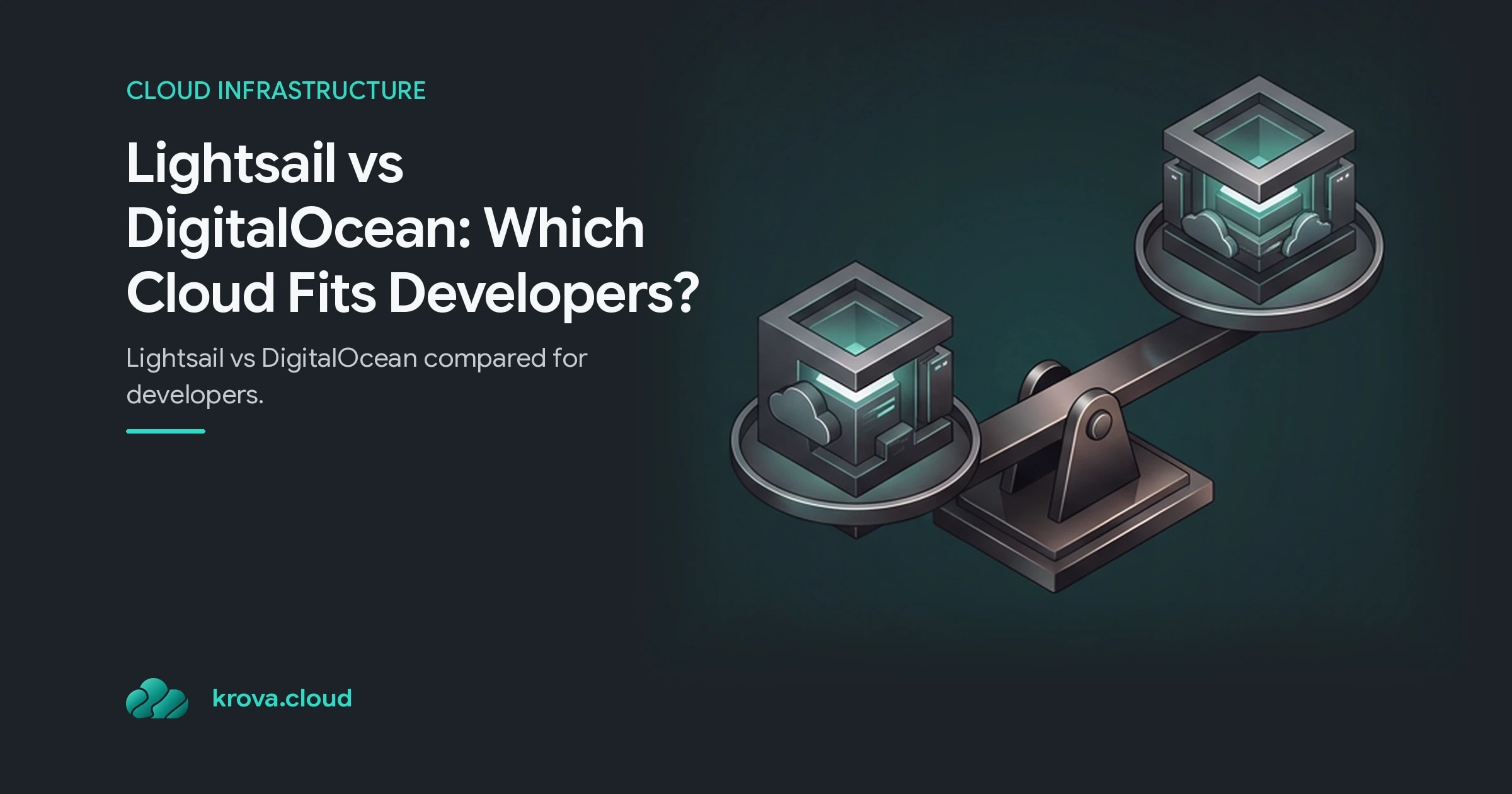
If you're evaluating Lightsail vs DigitalOcean, the server price is only part of the decision. Developers also need to think about predictable billing, storage options, control, and how much infrastructure they want to manage.
The core lightsail vs digitalocean choice comes down to two approaches: Lightsail offers a simpler path into AWS, while DigitalOcean focuses on straightforward developer infrastructure. The better fit depends on what you are building and how your workload behaves after deployment.
TL;DR:
- Lightsail packages compute, storage, and networking into fixed bundles and provides an easier entry point into AWS.
- DigitalOcean Droplets provide general-purpose VPS infrastructure with predictable pricing and root access.
- AWS becomes more appealing when your application benefits from services such as S3, RDS, or Lambda.
- Testing your real workload is more reliable than comparing advertised server prices alone.
What Is Lightsail vs DigitalOcean?
Lightsail is AWS's simplified VPS product. It bundles a virtual server, storage, and networking into fixed monthly packages, with preconfigured blueprints for common workloads such as WordPress, LAMP, and Node.js.
DigitalOcean takes a general-purpose VPS approach. Its Droplets provide Linux virtual machines with root access, consistent specifications, and straightforward pricing. DigitalOcean also offers managed services for developers who want more deployment flexibility.
The difference is less about raw compute and more about infrastructure philosophy. Lightsail is an easier route into the AWS ecosystem. DigitalOcean is built around a simpler developer cloud experience.
If you expect to build around AWS services, Lightsail can make that transition smoother. If you mainly need an independent VPS, DigitalOcean keeps the infrastructure model easier to understand.
For additional technical context, DigitalOcean's own comparison explains how it positions Droplets against Lightsail. DigitalOcean's Lightsail comparison is useful when you want the provider's current view of the two platforms.
Key Differences in Pricing, Control, and Infrastructure
The biggest practical difference is how each platform handles infrastructure decisions.
DigitalOcean is known for predictable pricing on its core VPS products. Lightsail uses fixed bundles, which make initial budgeting simple, but additional AWS services may introduce separate costs as an architecture grows.
For predictable infrastructure spending, compare the full setup, including storage, networking, and any services added later.
Performance should be tested against your own workload. When evaluating lightsail vs digitalocean, independent VPSBenchmarks testing has compared multiple plans across performance, features, and pricing, which is more useful than assuming one provider is always faster. See the VPSBenchmarks comparison.
Storage is another distinction. DigitalOcean offers more flexible storage options around its general-purpose infrastructure, while Lightsail emphasizes simplicity through bundled plans.
There is also the AWS ecosystem to consider in the lightsail vs digitalocean debate. If your application will eventually depend on S3, RDS, Lambda, or other AWS services, Lightsail can make that path more natural. If those services are not part of your stack, that advantage may matter less.
Which Cloud Fits AI Sandboxes, Docker, and Self-Managed Apps?
Your workload should decide the platform, not the other way around.
For a conventional web application, both options can work well. Developers can provision a VPS, install Docker or a web stack, configure networking, and manage the application directly.
AI-agent sandboxes and untrusted code introduce different requirements. A standard container can help separate processes, but workloads running unknown code may require stronger isolation boundaries.
For temporary CI or development environments, billing granularity also matters. A monthly VPS can be inefficient when environments run only for short periods.
Platforms built around isolated environments and usage-based billing may be worth considering for these cases.
For persistent applications, a conventional VPS can be enough. For short-lived or isolation-sensitive workloads, the billing model and isolation boundary deserve attention alongside server specifications.
When to Consider an AWS Lightsail Alternative
An AWS Lightsail alternative makes sense when Lightsail solves the first deployment but becomes restrictive for the workload you actually run.
Consider another provider when:
- Your traffic patterns are unpredictable and you want costs tied more closely to usage.
- Your workloads are temporary rather than continuously running.
- You need stronger isolation for certain workloads.
- You want full control without relying heavily on a larger cloud ecosystem.
- Storage or networking costs affect your total budget.
If you are finalizing a lightsail vs digitalocean decision, DigitalOcean is one alternative, especially if you want a conventional VPS with predictable pricing and a developer-focused workflow. Hetzner, Vultr, and Akamai's Linode are other options mentioned in the research, each with different tradeoffs around pricing, regions, and management.
The best AWS Lightsail alternative is the one that removes a limitation you actually have, rather than the one with the lowest advertised price.
A useful test is simple: provision the smallest configuration that can handle your real workload, run it for several days, measure usage, and compare the actual cost.
FAQ
Is DigitalOcean Cheaper Than AWS Lightsail?
DigitalOcean is often easier to forecast for basic VPS workloads because its core pricing is straightforward. Lightsail can be attractive when AWS ecosystem integration matters, but total cost depends on the complete architecture.
Is Lightsail Easier Than DigitalOcean?
Both platforms simplify VPS deployment. Lightsail hides more AWS complexity behind fixed bundles, while DigitalOcean focuses on a simpler developer-oriented workflow.
What Is a Good AWS Lightsail Alternative for Docker?
DigitalOcean is a conventional option for Docker workloads. Other platforms may make sense when you need specialized isolation or usage-based billing.
Should I Choose Lightsail or DigitalOcean for an AI Sandbox?
Start by defining the isolation requirements and workload lifetime. For persistent VPS infrastructure, either platform may fit. For temporary environments running untrusted code, compare isolation models and billing approaches carefully.
Skip the VPS debate. Run Firecracker.
Ditch the traditional VPS and launch your apps on Krova's Firecracker microVMs in seconds without managing any clusters.