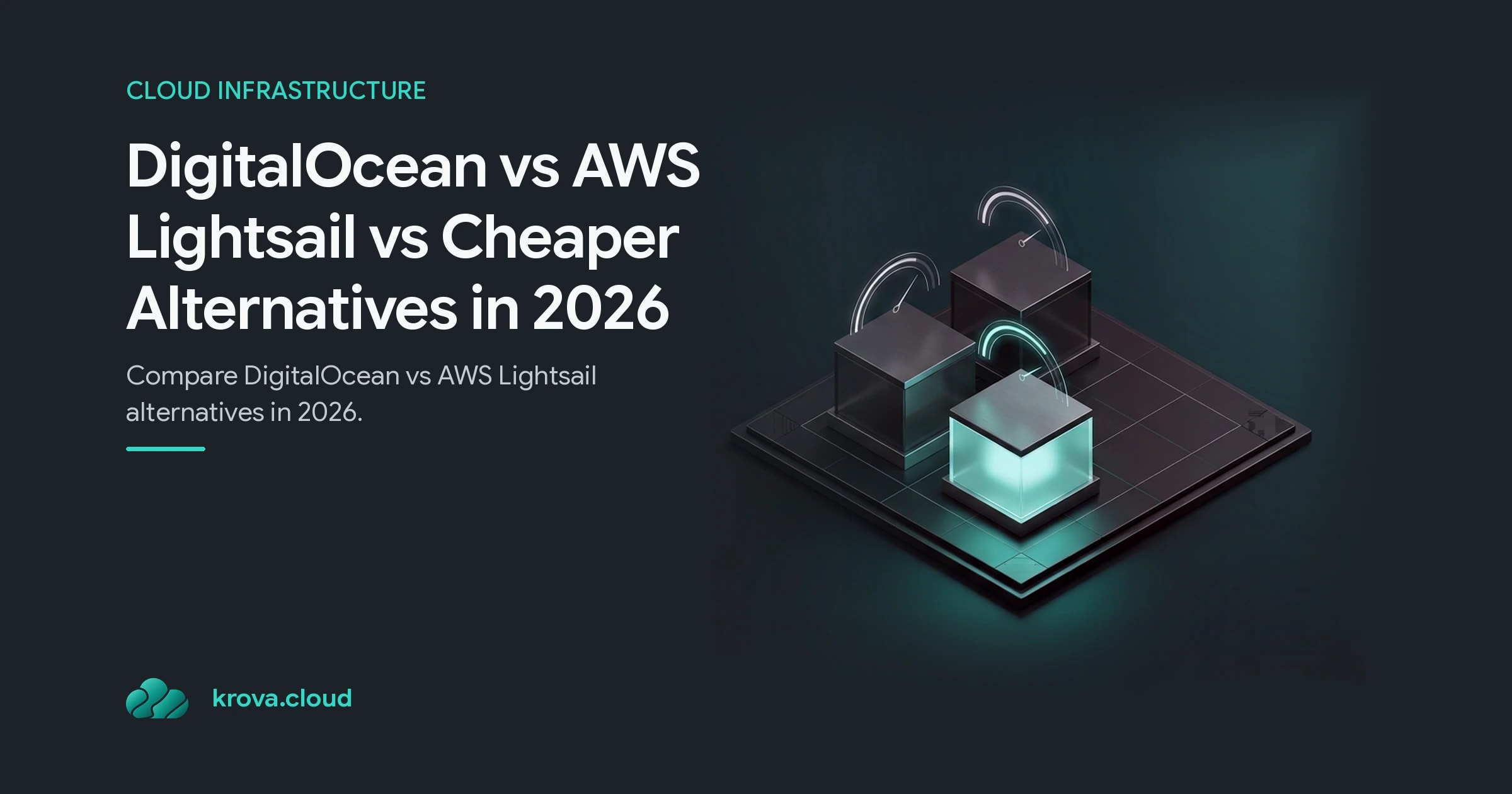
DigitalOcean vs AWS Lightsail vs Cheaper Alternatives in 2026
Compare DigitalOcean vs AWS Lightsail alternatives in 2026. See real prices, hidden egress fees, and cheaper VPS picks like Hetzner and Vultr before you deploy.
 DM
DMLast updated
One rate decides more migration plans than any feature table: AWS charges $0.05 to $0.09 per GB for data leaving, and the meter runs whether or not anybody is watching. A busy endpoint on a "cheap" $5 instance produces a bill that needs explaining. When evaluating DigitalOcean vs AWS Lightsail alternatives, these hidden costs make all the difference.
If you are weighing DigitalOcean vs AWS Lightsail alternatives for a side project, a startup backend, or an AI workload, 2026 gives you more genuinely affordable options than ever. The catch is that the flashy comparison charts rarely show you the fees that actually blow up your budget. That is why smart teams research DigitalOcean vs AWS Lightsail alternatives before they lock into any single provider.
Let's fix that. You'll get real prices, honest trade-offs, and a clear way to choose.
Why Your Cloud Bill Is Higher Than It Should Be
Most developers don't overpay because they picked the wrong instance size. They overpay because of pricing they never saw coming.
AWS uses a pay-as-you-go model that gets confusing fast. Data transfer, storage tiers, load balancers, and IP addresses all bill separately, and the total is hard to forecast until the invoice lands. Even Lightsail, which Amazon built specifically to feel simpler, still pulls you into that broader ecosystem the moment you outgrow the starter bundle.
DigitalOcean took the opposite approach with flat-rate, predictable pricing that stays the same across regions. You know what a Droplet costs before you spin it up, and it costs that whether you deploy in New York or Frankfurt.
The real question isn't just DigitalOcean versus Lightsail, it's whether either one is the cheapest way to get the isolated compute you actually need. Spoiler: often it isn't, which is exactly why DigitalOcean vs AWS Lightsail alternatives deserve a closer look.
What Are DigitalOcean and AWS Lightsail, Really?
Before you compare a single price, it helps to know what each one actually gives you.
DigitalOcean Droplets are general-purpose Linux virtual machines with consistent specs and flat pricing. You launch one, get root access, and deploy your app in minutes. DigitalOcean also runs a managed App Platform for push-to-deploy workflows, plus Cloudways for managed WordPress and Magento hosting with caching, firewalls, and SSL baked in.
AWS Lightsail is Amazon's simplified VPS product. It bundles a virtual server, storage, and networking for a fixed monthly price, with pre-configured blueprints for WordPress, LAMP, and Node.js. It's the friendliest door into AWS, designed to compete directly with DigitalOcean's simplicity.
The core difference comes down to philosophy. DigitalOcean gives you portability and predictable costs. Lightsail gives you a smooth on-ramp into the wider AWS ecosystem, which matters if you plan to lean on services like S3, RDS, or Lambda later.
For a basic website or API, both handle the job well. The moment your traffic grows or you add data transfer, Lightsail's costs get harder to forecast, while DigitalOcean's stay flat. That predictability is exactly why so many teams start hunting for a DigitalOcean alternative or an AWS Lightsail competitor in the first place, and why DigitalOcean vs AWS Lightsail alternatives has become such a common search.
The Best DigitalOcean vs AWS Lightsail Alternatives Compared
Here's where it gets interesting. The market of DigitalOcean vs AWS Lightsail alternatives in 2026 has several strong options, and the best one depends entirely on how much control you want.
Look at a rough apples-to-apples comparison for a 2-CPU box:
- DigitalOcean: 4 GB RAM, 2 CPU, 25 GB storage around $42/mo
- Vultr: 4 GB RAM, 2 CPU, 50 GB storage around $40/mo
- Akamai (Linode): 4 GB RAM, 2 CPU, 80 GB storage around $36/mo
- Hetzner: 8 GB RAM, 2 CPU, 80 GB storage around €12.49/mo
- AWS EC2 (Lightsail's bigger sibling): 4 GB RAM, 2 CPU, 80 GB storage around $52/mo
Read that Hetzner line again. You get double the RAM and triple the storage for roughly a quarter of the DigitalOcean price, which is why Hetzner keeps showing up as the value pick for teams who don't mind European data centers and a slightly barer interface.
Beyond raw VPS pricing, a few modern DigitalOcean vs AWS Lightsail alternatives are worth knowing:
- Vultr for global regions and CPU-optimized instances at a fair price.
- DigitalOcean App Platform if you want managed deploys without babysitting a server.
- Sliplane if your app already lives in Docker and you just want to ship containers.
- Coolify or Kamal if you want open-source, self-hosted deployment on hardware you rent cheap.
Most people get this wrong: they compare only DigitalOcean and Lightsail, then act surprised when a Hetzner or Vultr box does the same work for less. Broadening your view to the full field of DigitalOcean vs AWS Lightsail alternatives is how you avoid that trap.
Cheap VPS 2026: Where the Real Savings Hide
Chasing a cheap VPS 2026 setup is less about the sticker price and more about the fees stacked behind it.
Take a media-heavy API shipping 500 GB outbound a month. AWS meters that traffic at roughly $25 to $45 on top of the instance, every month, for as long as the endpoint stays busy. Hetzner and DigitalOcean fold transfer into flat allowances, so the same traffic costs close to nothing extra. This is where DigitalOcean vs AWS Lightsail alternatives quietly earn their keep.
So the savings hide in three places:
- Egress and bandwidth: the silent budget killer on AWS.
- Storage add-ons: block storage and snapshots that meter separately.
- Managed convenience: App Platform or Cloudways cost more than raw VPS but save you hours of ops work.
Here's the honest trade-off. A €12.49/mo Hetzner box is unbeatable on price, but you manage more yourself. A DigitalOcean App Platform deploy costs more, yet you never touch a server config. The cheapest server is only cheap if your time is free, so weigh the hours you'll spend, not just the monthly rate.
How to Pick the Right Host Without Overpaying
Skip the analysis paralysis. Run your decision through these questions:
- Do you need deep AWS integration later? If yes, Lightsail earns its spot as your on-ramp. If no, you're free to shop the DigitalOcean vs AWS Lightsail alternatives for value.
- How predictable is your traffic? Spiky or high-egress workloads favor flat-rate providers like DigitalOcean and Hetzner over AWS metering.
- How much ops do you want to own? More control means Hetzner or a plain VPS. Less means DigitalOcean App Platform or a managed layer.
- Are you shipping containers? Then a Docker-native platform beats a raw VPS you'd have to configure by hand.
- Do you need isolation for AI or multi-tenant workloads? MicroVM and container-based hosts give you tight isolation without the cost of a full dedicated box.
Start small and portable. Spin up the cheapest instance that fits your specs, run your real workload for a week, and watch the actual bill before you commit. Migrating a Droplet or a Docker app is far easier than untangling yourself from a deeply wired AWS setup six months in.
FAQ
Which Lightsail alternative fits a small team in 2026?
It depends on control versus convenience. Among DigitalOcean vs AWS Lightsail alternatives, Hetzner wins on raw price, giving you 8 GB RAM for around €12.49/mo. DigitalOcean App Platform wins for managed, push-to-deploy simplicity. Vultr and Akamai land in between with strong global coverage and predictable pricing.
Is DigitalOcean Cheaper Than AWS Lightsail?
DigitalOcean is usually more predictable rather than strictly cheaper, thanks to flat-rate pricing that stays consistent across regions. AWS costs are harder to forecast once egress ($0.05 to $0.09 per GB) and add-on services enter the picture, so comparing DigitalOcean vs AWS Lightsail alternatives on total bill matters more than the sticker price.
Which Cloud Is Easiest for Beginners?
DigitalOcean is widely considered the most beginner-friendly, with a clean interface, a simpler service catalog, and deep documentation. Lightsail is a close second because it hides most of AWS's complexity behind fixed monthly bundles.
What's the Cheapest VPS for a Small App in 2026?
Hetzner offers the strongest value for a small app, often delivering double the RAM and storage of comparable providers at roughly a quarter of the price. Just budget a little extra time for hands-on management, and keep the wider set of DigitalOcean vs AWS Lightsail alternatives in mind as your app grows.
Spin microVMs in seconds, not minutes
Skip the overhead of traditional VMs and launch workloads instantly on Krova's Firecracker microVMs without managing infrastructure.