Self-Hosted vs Managed Cloud: When DIY Actually Costs More
Self-hosted vs managed cloud: see the hidden costs, real TCO math, and when DIY hosting quietly burns more money than a managed plan ever would.
 RB
RBLast updated
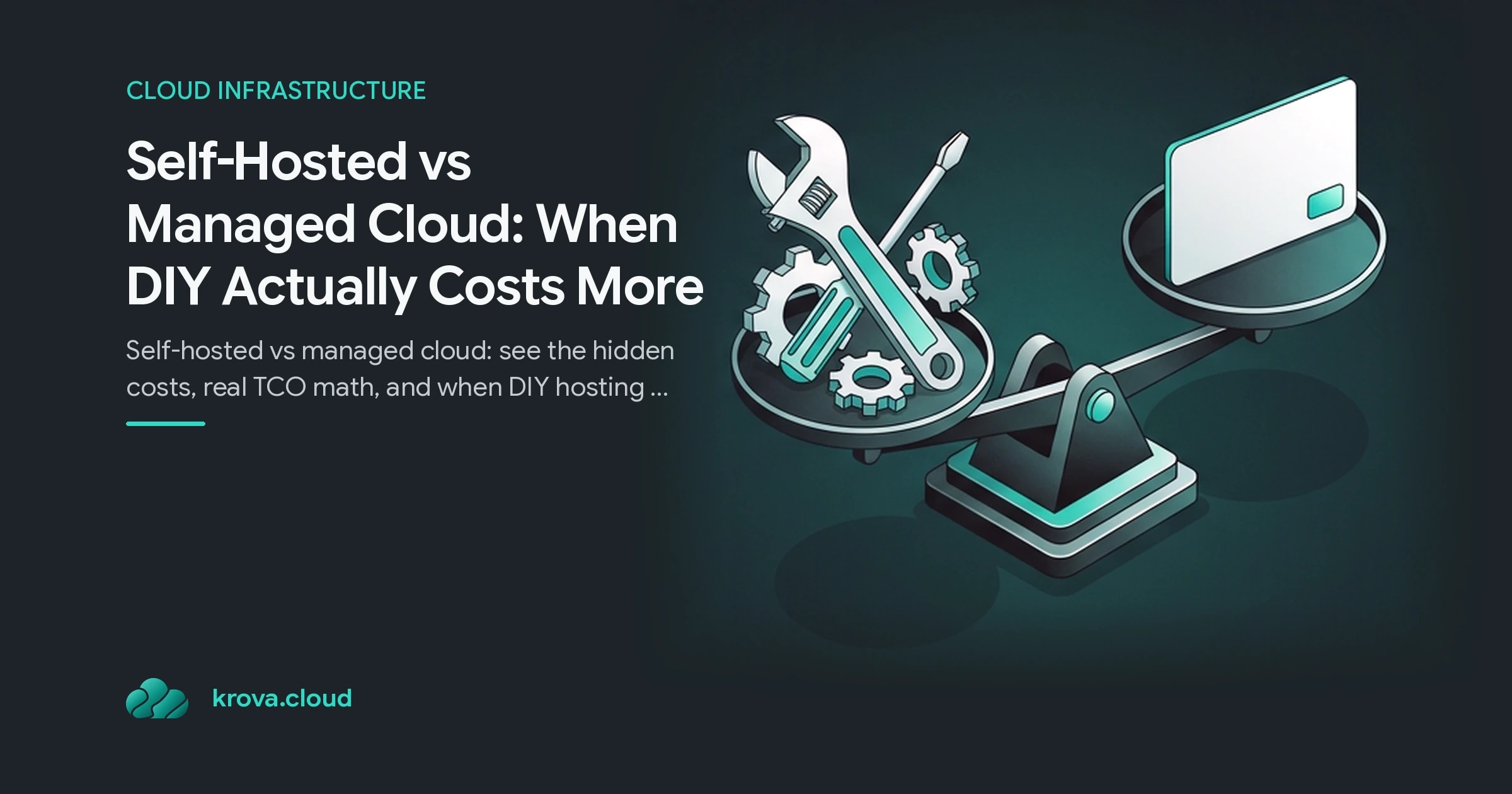
That $20-a-month VPS you're proud of isn't $20 a month. Once you count the Saturday you spent patching it, the 2 a.m. page when the disk filled up, and the security review you keep postponing, the sticker price is the smallest number in the equation. When evaluating self-hosted vs managed cloud solutions, these hidden operational costs often shift the economics entirely.
The self-hosted vs managed cloud debate almost always gets framed as "cheap and hands-on" versus "expensive and easy." That framing is wrong often enough to cost you real money. In the self-hosted vs managed cloud tradeoff, self-hosting can absolutely win on long-term cost at scale, but it can just as easily bleed you dry in engineering hours you never invoiced. Let's figure out which side of that line your workload actually lands on.
What Self-Hosted vs Managed Cloud Actually Means
Self-hosting means you own the whole stack end to end. You provision the machine, harden it, patch it, monitor it, back it up, and stay on the hook when it breaks. That includes both on-premise servers and cloud instances your team manages entirely, which is the oldest and most demanding deployment model there is.
Managed cloud flips the responsibility. The provider handles the infrastructure, the tooling, dependency and stack updates, and the operational grunt work. You get compute that just runs, and you trade some control for a lot fewer things that can wake you up.
The core tension in every self-hosted vs managed cloud decision is control versus convenience, and neither is free. Self-hosting maximizes control and lets you tailor infrastructure to your exact app. Managed platforms outsource that investment so your engineers can build the product instead of babysitting the box.
Say you're an AI/ML builder spinning up isolated microVMs for untrusted inference workloads. Self-hosting gives you total say over isolation and networking. A managed layer gives you back the week you'd otherwise spend wiring up firewalls and access control. Both are valid, and the self-hosted vs managed cloud call comes down to the math.
The Hidden Self-Hosted Cloud Cost Nobody Puts on the Invoice
Here's where the DIY story falls apart for a lot of teams. The real self-hosted cloud cost isn't the server rental. It's everything wrapped around it.
Run the tally honestly:
- Engineering time. Every hour spent patching, configuring firewalls, and setting up encrypted access is an hour not shipping features. If a senior engineer costs you $80 an hour and self-hosting eats 6 hours a week, that's roughly $1,900 a month before you've served a single request.
- Security ownership. You're responsible for strict firewall policies, encrypted communication, strong authentication, and keeping management interfaces off the public internet. Tools like WireGuard or Tailscale help, but someone has to set them up and keep them current.
- Downtime risk. When self-hosted infrastructure fails, there's no support queue. You are the support queue.
- Hardware and upgrade cycles. On-premise self-hosting means eating expensive hardware and software refreshes on your own schedule.
Most people get this wrong: they compare the managed monthly bill against the self-hosted rental fee and skip the labor entirely. That's not a comparison, that's a fantasy. In any honest self-hosted vs managed cloud tally, the moment you add fully loaded engineering hours, the "cheap" option often stops being cheap.
Self-hosting genuinely wins on long-term cost when you have the scale and the ops muscle to absorb that overhead. Below that threshold, DIY is a subscription you pay in weekends.
When Managed Cloud Quietly Wins the TCO Math
Managed cloud earns its price on speed, simplicity, and reduced operational overhead. You get resources on demand, real-time scaling, and none of the hardware refresh headaches. For a small team, that convenience frees people to focus on core business development instead of infrastructure plumbing.
But it comes with two honest trade-offs you should size up before you commit.
The first is vendor lock-in. When the provider owns the tooling and the platform, migrating off later can be painful and slow. The second is cost predictability. Managed and consumption-based pricing can spike in ways a fixed self-hosted box never would, especially with egress fees and burst usage.
Managed cloud is the smarter buy whenever your team's time is worth more than the premium you pay to avoid running infrastructure. For most early-stage startups, that's true from day one. Your five engineers are your entire product velocity. Spending 20% of that on server maintenance is the most expensive decision on the whiteboard.
The research keeps landing on the same conclusion across every source: in the self-hosted vs managed cloud question there's no one-size-fits-all winner. Managed cloud wins on operational overhead and speed. Self-hosting wins on control, privacy, and cost at scale.
A Managed VPS Comparison That Reframes the Whole Debate
Do a quick managed VPS comparison and the trap becomes obvious. Two plans might list the same vCPU and RAM, but the cheaper one is unmanaged. You patch it, you secure it, you fix it. The pricier one includes updates, monitoring, and support.
Run the numbers per month for a modest production workload:
- Unmanaged VPS: $25 base, plus roughly 5 engineering hours at $80 = about $425 all-in.
- Managed equivalent: $70 base, near-zero recurring engineering hours = about $70 all-in.
That's not a close call. The unmanaged box looks 64% cheaper on the invoice and ends up costing six times more once labor is counted. This is the self-hosted vs managed cloud gap in miniature, and it only closes when you're running enough instances that per-server overhead shrinks, which is exactly the scale point where self-hosting starts to make sense.
A hybrid approach threads the needle for a lot of teams. Run managed cloud where convenience matters most, like fast-moving app tiers and unpredictable workloads. Self-host the pieces where control and privacy are non-negotiable, or where steady, high-volume usage makes the fixed cost pay off. Virtualization and microVMs make this split cleaner than it used to be, letting you carve isolated environments without dedicating full machines.
How to Run Your Own Cloud TCO Analysis in an Afternoon
Skip the vibes. A real cloud TCO analysis takes an afternoon and settles the self-hosted vs managed cloud argument with numbers instead of opinions.
Work through this checklist:
- List every cost line for both options. Base compute, storage, bandwidth and egress, backups, and support.
- Add fully loaded labor. Estimate weekly hours for patching, security, and incident response, then multiply by your true hourly engineering cost.
- Price the risk. Assign a rough dollar value to downtime and to a security incident you'd have to handle alone.
- Factor exit cost. For managed options, estimate how much a future migration would cost if lock-in becomes a problem.
- Project across 12 to 36 months. Self-hosting's advantage usually only shows up over a longer horizon and at higher volume.
Whichever direction you go, harden it either way: strict firewall rules, encrypted communication, strong authentication, and no management interface exposed to the open internet.
Add up both columns. If your DIY total is higher once labor and risk are in the spreadsheet, you have your answer, and it's the one most small teams don't expect.
FAQ
Is self-hosting always cheaper than managed cloud? No. In the self-hosted vs managed cloud comparison, self-hosting can be cheaper at scale, but once you add engineering labor, security ownership, and downtime risk, small-team self-hosting often costs several times more than a managed plan for the same workload.
What's the biggest hidden self-hosted cloud cost? Engineering time. Patching, firewall configuration, monitoring, and incident response can quietly consume thousands of dollars a month in labor that never appears on the server invoice.
When does managed cloud make the most sense? When your team's time is scarce and your workload is unpredictable. In a self-hosted vs managed cloud decision, managed cloud wins on speed, simplicity, and reduced operational overhead, which matters most for early-stage teams shipping fast.
Can I combine self-hosted and managed cloud? Yes, and it's the pragmatic default. A hybrid self-hosted vs managed cloud setup runs managed cloud where convenience matters and self-hosts the pieces that demand control, privacy, or steady high-volume usage. MicroVMs make splitting workloads cleaner.
The Verdict Comes Down to Your Spreadsheet
Don't decide self-hosted vs managed cloud on gut feel or the monthly sticker price. Build the TCO table, load in the real labor and risk numbers, project it across two to three years, and let the totals argue for you.
Stop the DIY Cloud Math, Run on Krova
Skip self-hosted overhead: spin up managed microVMs in seconds and trim infrastructure costs without Kubernetes clusters.