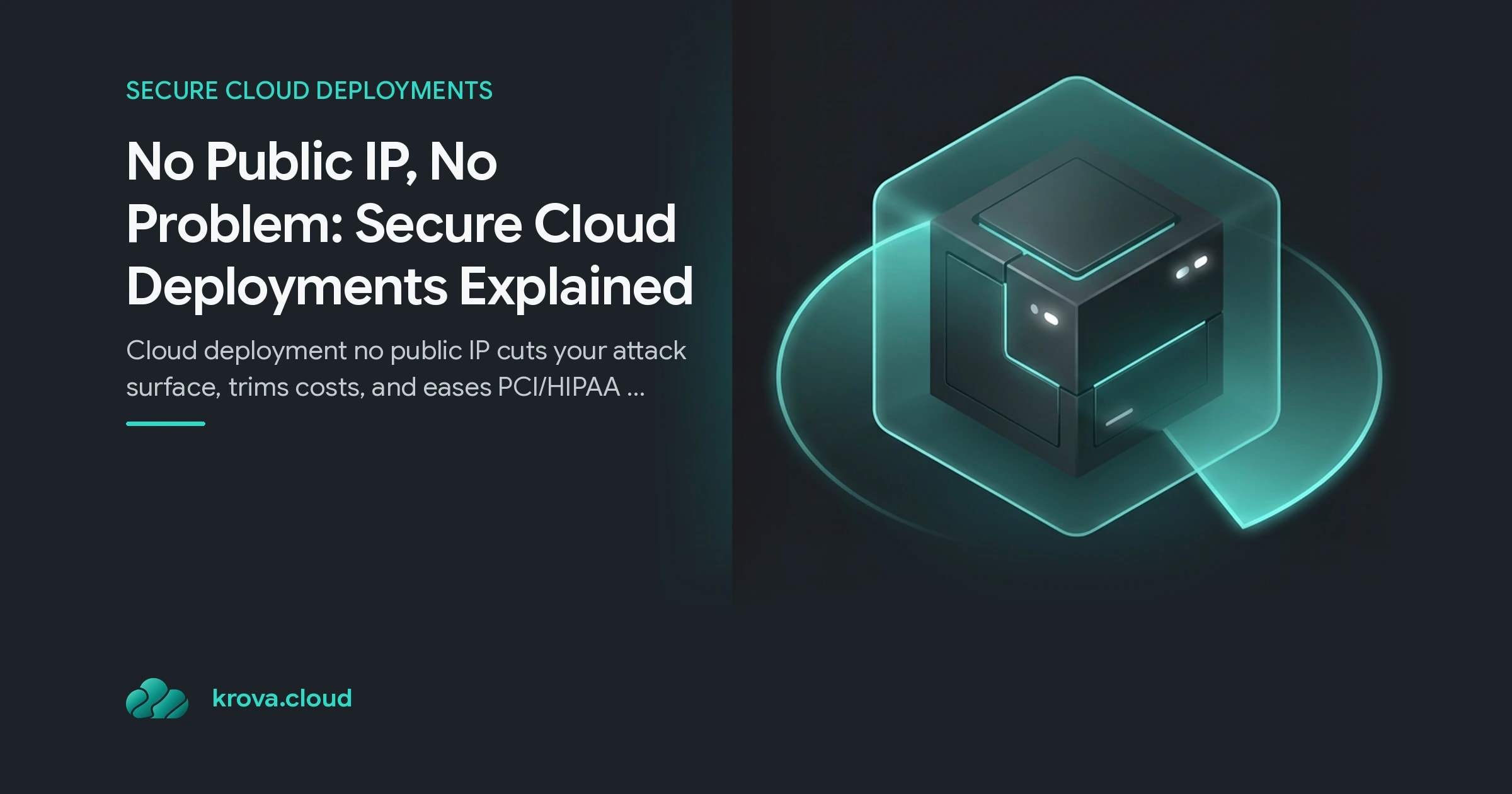
No Public IP, No Problem: Secure Cloud Deployments Explained
Cloud deployment with no public IP cuts your attack surface, trims costs and eases PCI/HIPAA compliance. How to run isolated compute without exposing a thing.
 RB
RBLast updated
Every public IP you assign is a door someone can knock on. And on the open internet, someone is always knocking. Cloud deployment with no public IP eliminates that exposure entirely. Automated scanners hit exposed servers within minutes of them coming online, probing for open ports and weak credentials.
So here's the question worth asking before your next launch: does this workload actually need to face the internet? For a database, an internal API, a background worker, or an AI inference job talking only to your own services, the answer is almost always no. A cloud deployment with no public IP removes that door entirely, cutting your attack surface, trimming your bill, and making compliance auditors a lot happier.
Let's break down how a cloud deployment no public IP setup works and how to do it without painting yourself into a corner.
What Is Cloud Deployment With No Public IP?
A cloud deployment no public IP means your compute instances get a private address that's only reachable inside your own network, never directly from the internet. Think of it as an unlisted phone number. The machine still runs, still talks to your other services, and can still reach out to the internet through a controlled gateway. It just can't be dialed directly by a stranger.
Most cloud platforms build this around a Virtual Private Cloud, or VPC, a logically isolated network carved out just for you. Inside that private cloud network, your resources are provisioned exclusively for your organization and walled off from other tenants. AWS even ships a managed rule (ec2-instance-no-public-ip) whose entire job is to flag any instance that got a public address it didn't need.
The key distinction: a cloud deployment no public IP is about ingress. Nobody outside can start a connection to your box. Your box can still start connections outward when you allow it, so package installs and API calls keep working.
Why a No Public IP Server Shrinks Your Attack Surface
The security math is refreshingly simple. If you run a cloud deployment no public IP, there's no direct path for an outside attacker to reach that server. Port scanners find nothing. Brute-force bots have nowhere to aim. You've removed an entire category of unauthorized-access and remote-exploit risk before writing a single firewall rule.
That's exactly the reasoning AWS gives: a public IP address can expose an instance to unauthorized access or attacks, and many workloads simply don't need one.
The benefits stack up fast:
- Stronger cloud network security by default. Your baseline posture is "closed," not "open and hopefully patched."
- Easier compliance. Standards like PCI DSS and HIPAA demand real network segmentation and access controls. Keeping instances off the public internet is one of the cleanest ways to satisfy those requirements instead of arguing with an auditor about your firewall config.
- Lower cost. Public IPv4 addresses now carry per-address charges on major clouds. Multiply that across a fleet of internal cloud services and the savings are real, not rounding-error money.
Say you run 40 background workers that only ever talk to a queue and a database. Every one of them with a public IP is a needless cost and a needless risk. A cloud deployment no public IP strips those addresses and nothing about their job changes.
How Private Cloud Networks Route Traffic Without Exposure
A cloud deployment no public IP doesn't mean "no connectivity." Your services still need to reach each other and occasionally the outside world. Here's how traffic actually flows in a well-designed private cloud network.
Internal service-to-service traffic stays entirely on private addresses. Your API talks to your database over the private network, fast and unexposed. This is where internal cloud services shine, since they were never meant to be public in the first place.
Outbound internet access goes through a NAT gateway or an egress proxy. Your no public IP server can pull dependencies, call third-party APIs, and send webhooks, but the connection is always initiated from the inside. Nothing outside can reverse it.
Your own access comes through a controlled entry point rather than an open SSH port. Common patterns:
- A bastion host or jump box that's the single audited doorway in
- A VPN or private tunnel into the VPC
- Identity-aware session tools that broker access without any listening port at all
Public-facing pieces (if you have any) get isolated at the edge. A load balancer or reverse proxy in a public subnet accepts internet traffic and forwards it to your private instances, so the machines doing the real work never touch the internet directly.
The result is a layered design where the internet only reaches a thin, hardened front door, and everything behind it lives in the quiet.
The Real Trade-Offs (and Mistakes People Make)
Choosing a cloud deployment no public IP is a clear win for most workloads, but it isn't free of friction. Knowing the trade-offs up front saves you a frustrating afternoon.
The convenience tax. You can't just ssh root@public-ip anymore. You'll set up a bastion, VPN, or session broker. That's a one-time cost that pays for itself the first time a scanner would have found an open port.
The debugging gotcha. New teams often deploy a private instance, then panic when apt install hangs. Nine times out of ten, they forgot the NAT gateway or egress route. No outbound path means no package installs and no external API calls. Configure egress before you deploy, not after.
The lock-in question. Managed private cloud options let you ship the newest networking features without mastering the low-level plumbing yourself. The trade-off is less control over the underlying infrastructure. If avoiding vendor lock-in matters to you, favor providers built on portable, open technology so you can move workloads later without a rewrite.
The most common mistake of all: leaving public IPs on instances that never needed them, purely out of habit. Audit your fleet. Every instance that only talks to internal services should lose its public address today.
How to Ship Your First No Public IP Deployment
You don't need a data-center migration to start. Try a cloud deployment no public IP on one non-critical service this week:
- Pick a target. Choose an internal worker, cache, or database that has no reason to face the internet.
- Launch it into a private subnet with no public IP assigned.
- Add an egress path (NAT gateway or proxy) so it can reach out when needed.
- Set up one controlled entry point for your team, a bastion, VPN, or session tool.
- Turn on an audit rule like
ec2-instance-no-public-ipto catch any future instance that drifts back to being exposed.
Run it for a few days. You'll notice the same thing everyone does: the service works exactly as before, your logs go quiet from scanner noise, and your next launch feels obvious. Private by default, public only on purpose.
FAQ
Can a server with no public IP still access the internet? Yes. Outbound traffic routes through a NAT gateway or egress proxy, so your instance can install packages and call external APIs. It just can't accept connections that originate from the internet.
How do I connect to a no public IP server for maintenance? Use a bastion host, a VPN into your VPC, or an identity-aware session broker. Each gives you a single audited doorway instead of an open SSH port exposed to the world.
Does a cloud deployment no public IP actually save money? It can. Major clouds now charge per public IPv4 address, so removing them across a fleet of internal services trims recurring cost while also lowering your risk.
Is a cloud deployment no public IP enough for PCI or HIPAA compliance? It's a strong building block, since both standards require network segmentation and access controls. Pair it with encryption, logging, and least-privilege access to cover the full requirement.
Deploy Securely in Seconds
Spin up isolated microVMs instantly without managing Kubernetes, perfect for private cloud deployments.