Agent Sandbox Comparison: Krova, E2B, Modal, Fly
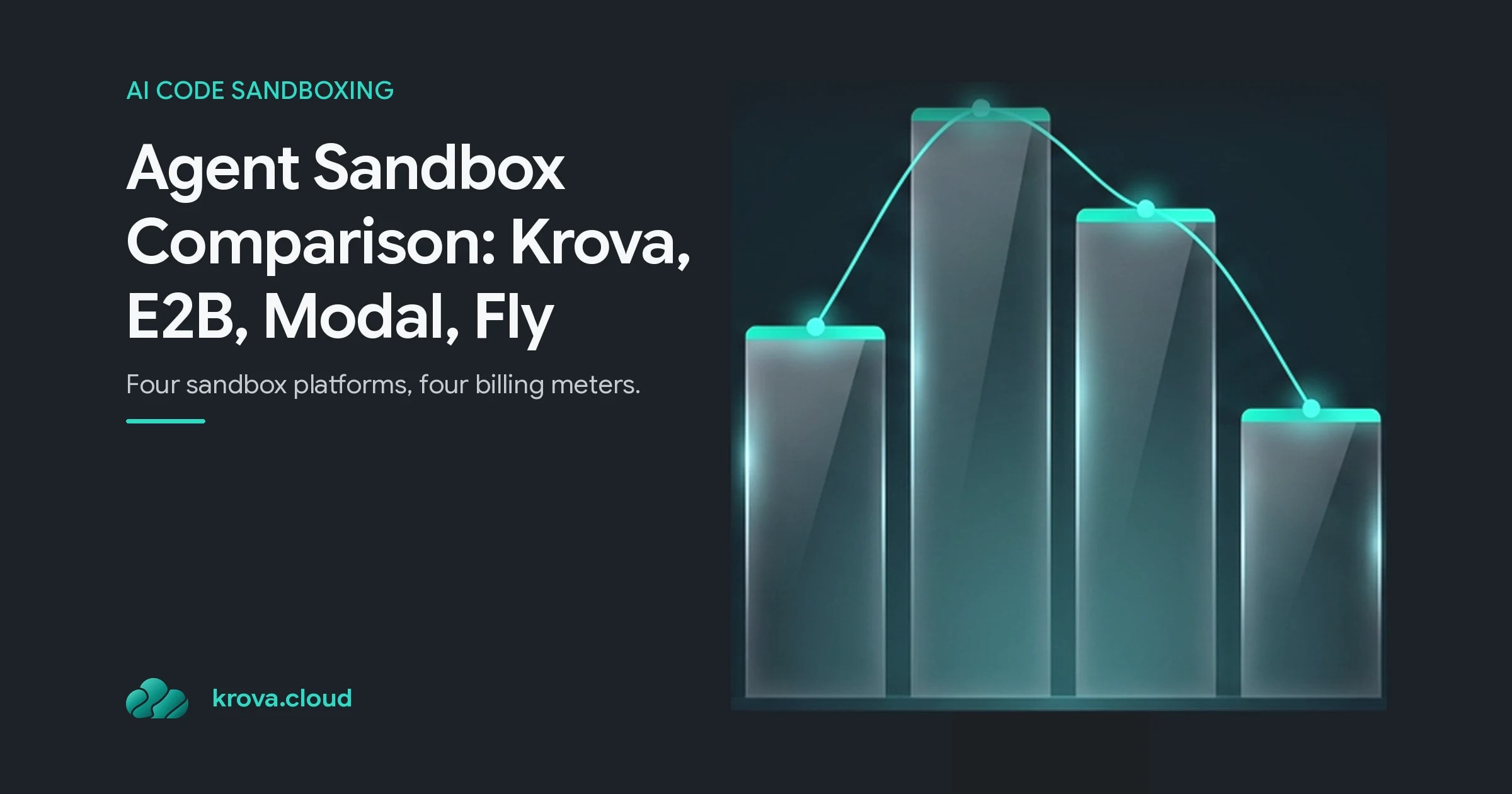
Four sandbox platforms, four billing meters. We compare Krova, E2B, Modal and Fly Sprites on idle cost, persistence and isolation, with October rates.
Agent Sandbox Comparison: Krova, E2B, Modal, Fly
An agent sandbox comparison is really a comparison of billing meters and idle behaviour. Headline vCPU rates cluster within a factor of two, but what the meter counts while your agent waits on a model decides the invoice. We checked the four platforms below against their public pricing and docs on 22 October 2026, and we kept Krova in the table because excluding ourselves would make the comparison less useful, not more honest.
How to read a rate card
Three questions separate the platforms. What does the meter count: wall clock, actual CPU use, or the higher of requested and used? What happens when the sandbox sleeps: does billing stop, and does state survive? What is the isolation boundary: a guest kernel, a sandboxed container runtime, or something unnamed? Answers to those three predict your bill better than any posted price. We read all four pricing pages on the same morning, 22 October 2026, and wrote down the idle clause before anything else. Every row in this comparison descends from that one line.
Session caps deserve the same attention as rates, because a cap turns into queued agents the moment a team scales. E2B's Pro plan allows 100 concurrent sandboxes; Modal's Team plan raises that to 5,000; Fly publishes no cap at all. Concurrency limits are a hidden pricing tier.
E2B
E2B bills wall clock per second at $0.0504 per vCPU-hour and $0.0162 per GiB-hour, per its pricing page. Billing stops when a sandbox pauses, and pause keeps memory state. The Pro plan costs $150 per month and caps you at 100 concurrent sandboxes with 24-hour sessions. Isolation is a Firecracker microVM with its own guest kernel, which is the strongest boundary in this table. Idle costs you money until you pause.
Modal Sandboxes
Modal bills per second on the higher of requested and used resources, at about $0.0710 per vCPU-hour (posted as $0.1419 per physical core) and $0.0240 per GiB-hour, per the rate tables compiled by Beri and Upstash. There is no pause state in the sandbox product, so an environment that exists is an environment that bills. Isolation is gVisor by default with an optional VM runtime. The Team plan floor is $250 per month.
Fly Sprites
Fly Sprites bills CPU and memory actually used while the Sprite is active, and compute billing stops when it sleeps, per Fly's own learn pages. Retained disk still bills, at hot and cold storage rates. Fly does not name an isolation technology on its pricing page, which we treat as a real data point rather than an oversight. Session length has no published cap, which suits long-lived agent workspaces.
Krova
Krova runs Firecracker microVMs with per-minute billing and no subscription floor, the model we describe in our microVM architecture explainer. You pay for minutes a box exists, sleeping or not, but you can destroy and recreate from a snapshot in seconds, which is the workflow we recommend in building isolated coding agents. The trade is honest: no free idle, no surprise meters.
Isolation naming matters for procurement too. A named guest kernel survives a security review in one meeting; an unnamed boundary generates a questionnaire. We saw that asymmetry in every vendor discussion we tracked this quarter, and it favours the platforms that publish their technology.
What the meters mean for agent loops
An agent loop that thinks for thirty seconds between two-second commands is mostly idle. On a wall-clock meter that idle is billed; on an actual-use meter it is nearly free; on per-minute billing it rounds up. This is why benchmark tradeoffs and what a microVM is matter less to your invoice than the idle clause. We found the same pattern across every rate card we read this week.
Choosing between them in one pass
List your loop shape first: idle-heavy interactive, batch rollouts, or long-lived workspaces. Match the meter to that shape, then check the plan floor against your expected monthly usage, and only then compare headline rates. Teams that skip the first step optimise a number they will never pay.
Verdict
Pick the meter that matches your loop shape first, then compare rates. Idle-heavy interactive agents suit actual-use billing; batch rollouts suit wall clock with aggressive teardown; regulated workloads suit a named guest-kernel boundary regardless of meter.
Limitations
- Rates and plan floors were read on 22 October 2026 and will drift; however, meter behaviour moves slower.
- We did not run identical workloads on all four platforms; this is a pricing and docs comparison.
- Fly does not publish its isolation technology, so that row is unknown rather than weak.
- Krova is our own product, so weight our self-assessment accordingly, but check the primary pages yourself.
FAQ
Which sandbox is cheapest for idle-heavy agents?
Fly Sprites, because compute billing stops while the Sprite sleeps. Wall-clock platforms bill the thinking time.
Which has the strongest isolation boundary?
E2B and Krova both use Firecracker microVMs with a dedicated guest kernel, the boundary we would choose for untrusted code.
Do plan floors matter for small teams?
Yes. A $150 or $250 monthly floor can exceed usage for a small team, making a floor-free platform cheaper at low volume.
{
  "@context": "https://schema.org",
  "@graph": [
    {
      "@type": "BlogPosting",
      "headline": "Agent Sandbox Comparison: Krova, E2B, Modal, Fly",
      "datePublished": "2026-10-22",
      "dateModified": "2026-10-22",
      "author": {"@type": "Organization", "name": "Krova Cloud Engineering"},
      "publisher": {"@type": "Organization", "name": "Krova Cloud"},
      "mainEntityOfPage": "https://krova.cloud/blog/agent-sandbox-comparison-krova-e2b-modal-fly"
    },
    {
      "@type": "FAQPage",
      "mainEntity": [
        {
          "@type": "Question",
          "name": "Which sandbox is cheapest for idle-heavy agents?",
          "acceptedAnswer": {"@type": "Answer", "text": "Fly Sprites, because compute billing stops while the Sprite sleeps. Wall-clock platforms bill the thinking time."}
        },
        {
          "@type": "Question",
          "name": "Which has the strongest isolation boundary?",
          "acceptedAnswer": {"@type": "Answer", "text": "E2B and Krova both use Firecracker microVMs with a dedicated guest kernel, the boundary we would choose for untrusted code."}
        },
        {
          "@type": "Question",
          "name": "Do plan floors matter for small teams?",
          "acceptedAnswer": {"@type": "Answer", "text": "Yes. A $150 or $250 monthly floor can exceed usage for a small team, making a floor-free platform cheaper at low volume."}
        }
      ]
    }
  ]
}