Breach Cost Per Target: The $50 Campaign
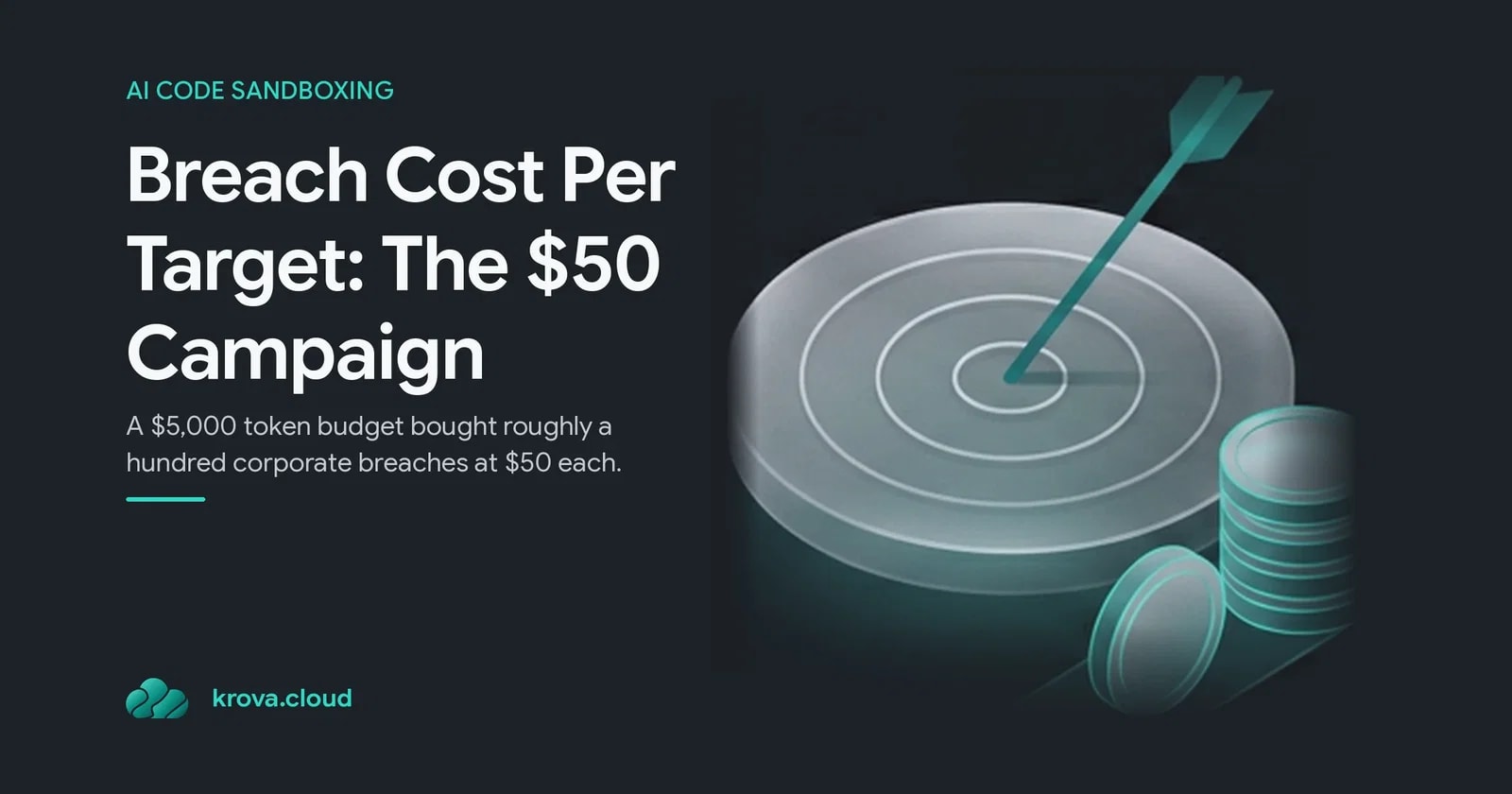
A $5,000 token budget bought roughly a hundred corporate breaches at $50 each. When the cost per win falls this far, every exposed asset gets probed.
 RB
title: "Breach Cost Per Target: The $50 Campaign" slug: "2026-10-31-breach-cost-per-target-the-50-campaign" meta_title: "Breach Cost Per Target: The $50 Campaign" meta_description: "The Cairn campaign breached 100-plus firms at about $50 per win on $5,000 of tokens. What that breach cost per target does to your exposure window." primary_keyword: breach cost per target author: Rohit Bhadani date: 2026-10-31 schema: BlogPosting+FAQPage category: AI Code Sandboxing secondary_keywords: autonomous cyberattack economics, AI agent breach campaign, exposure window, Cairn campaign, defensive cost math excerpt: "A $5,000 token budget bought roughly a hundred corporate breaches at $50 each. When the cost per win falls this far, every exposed asset gets probed."
Breach Cost Per Target: The $50 Campaign
A single operator pointing autonomous AI agents at more than 1,200 websites breached over 100 companies, including Deere, SharkNinja and Cummins, for about $5,000 of model tokens, reported by Reuters and summarized in Fortune's 21 October analysis. Divide the spend by the wins and the breach cost per target lands near $50, with a typical time to success around 23 hours per company.
The campaign mechanics are publicly documented. It began on 25 September, used roughly two dozen exposed Cairn instances from early October, and ran on written instructions under 100 Chinese characters, per the campaign breakdown published by Shattered. Targets spanned the United States, Canada, Australia and Japan, which tells small teams everywhere that geography bought nobody time.
What a low breach cost per target changes
Security budgeting assumes attackers price their time. At $50 and 23 hours per win, the attacker's marginal cost of trying your perimeter is close to zero, so every internet-reachable asset gets attempted eventually, not selectively.
That inverts the classic exposure math. A window that stayed open for days used to matter only if someone noticed you; now the probe arrives as reliably as weather, and the window itself is the loss event, as our PwnEscape patch-window analysis showed for kernel-class flaws.
The defensive arithmetic that follows
Spend your money on window size, not on being uninteresting. Ephemeral environments that exist for minutes present a target that is gone before a 23-hour campaign cycle reaches it, the same property our env var secrets audit values for credential blast radius.
Shrink the credential prize inside each window. Scoped, short-lived tokens mean a successful probe recovers minutes of access rather than a standing key, which converts a breach into a logged blip, the pattern we recommend in safe agent sessions.
Count your reachable surface in assets-times-hours, not assets. One exposed admin panel for a weekend is 48 asset-hours of campaign exposure; the same panel behind an allowlist for ten minutes of maintenance is a sixth of one. Run the probe math on your own surface once a quarter. List every asset an outsider can reach, multiply by hours exposed, and price the top three windows against the cost of closing them. The exercise usually finds that one forgotten admin panel outweighs a year of runner savings.
Why autonomy makes the cost floor stick
Human attackers sleep, negotiate and reuse tooling slowly. Agent campaigns replay the same playbook across 1,200 sites in parallel, and the token bill scales linearly while successes compound, which is why Fortune's sources expect the model to spread rather than fade.
We checked the campaign figures on 31 October against the Reuters-derived summaries, and the $50 figure holds as an order of magnitude even if individual wins cost more.
Verdict
We recommend pricing your exposure in asset-hours and capping it with ephemerality, allowlists and scoped credentials, because the attacker's cost per win now sits below the price of a manual probe. The campaign proved the playbook; the arithmetic says it arrives everywhere.
Limitations
- The $50 figure divides reported token spend by reported wins; however, operator costs beyond tokens are unknown.
- Company counts come from researcher observation of exposed Cairn instances, so the true target pool may differ.
- We have not reproduced any part of the campaign, but our window math is defensive reasoning, not measured probe rates.
- Attribution of the instructions' language and tooling rests on researcher reports we cannot independently verify.
FAQ
Why does a $50 breach cost matter to a small team?
Because it removes attacker triage. Cheap attempts mean your assets get probed for existing, not for value, so window size beats obscurity.
Does ephemerality stop a 23-hour campaign?
It removes the standing target the campaign cycle needs. An environment that lives minutes cannot be profiled across a day-long attack chain.
What shrinks the credential prize fastest?
Short-lived scoped tokens issued per session, with rotation on expiry. Standing keys are the asset that makes a $50 breach worth $50,000.