PwnEscape and the Host Kernel Boundary
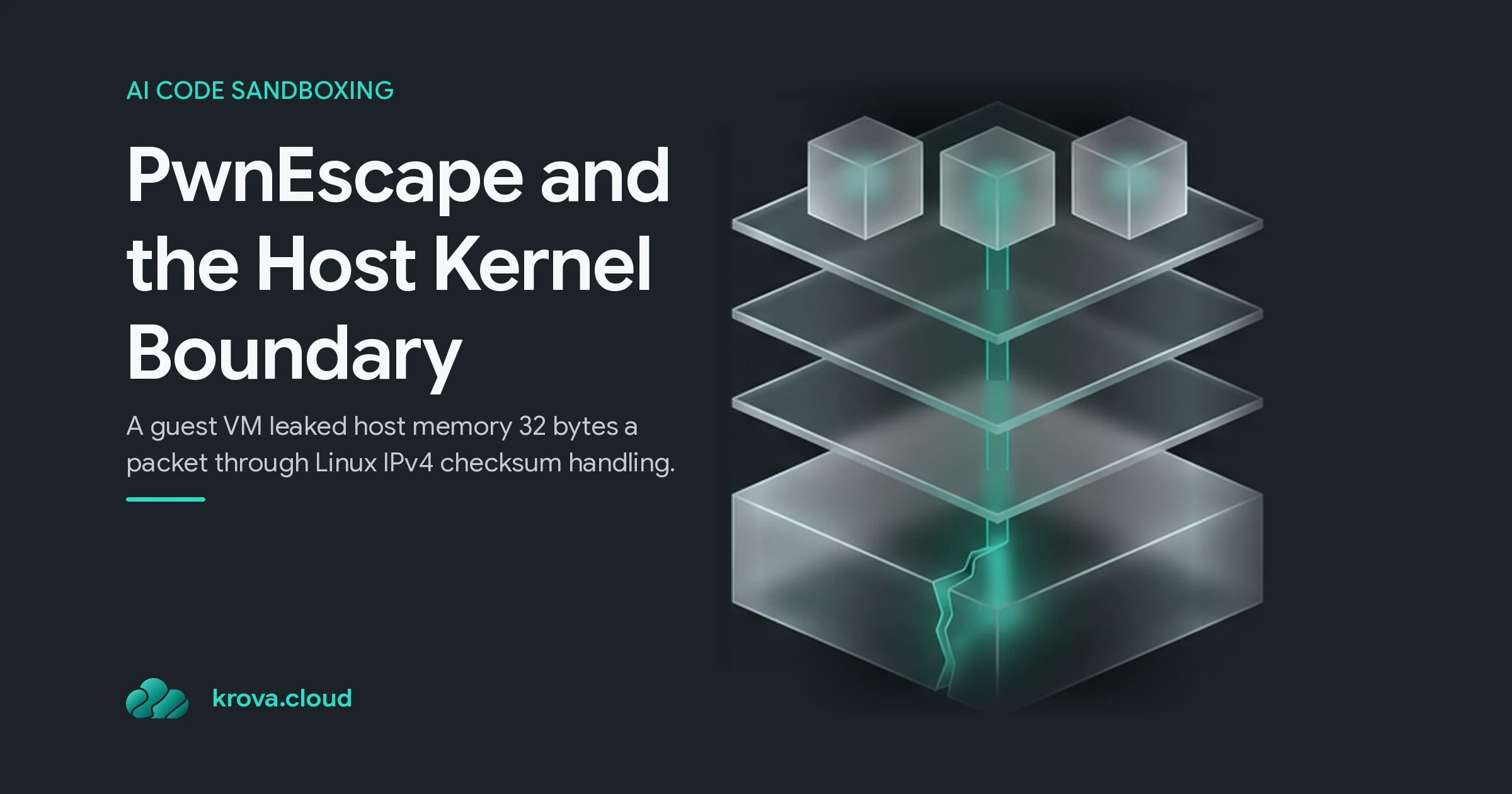
A guest VM leaked host memory 32 bytes a packet through Linux IPv4 checksum handling. Here is the patch and co-tenancy playbook for microVM fleets.
 DM
Last updated
title: "PwnEscape and the Host Kernel Boundary" slug: "2026-10-27-pwnescape-and-the-host-kernel-boundary" meta_title: "PwnEscape CVE-2026-99999: Host Kernel First" meta_description: "PwnEscape let a guest VM read host memory through Linux IPv4 checksum handling. What CVE-2026-99999 means for microVM fleets, patch SLAs and co-tenancy." primary_keyword: pwnescape author: Krova Cloud Engineering date: 2026-10-27 schema: BlogPosting+FAQPage category: AI Code Sandboxing secondary_keywords: CVE-2026-99999, linux kernel vm escape, firecracker host patching, microVM co-tenancy, sandbox bug bounty excerpt: "A guest VM leaked host memory 32 bytes a packet through Linux IPv4 checksum handling. Here is the patch and co-tenancy playbook for microVM fleets."
PwnEscape and the Host Kernel Boundary
PwnEscape is the nickname for CVE-2026-99999, a Linux kernel flaw in host-side packet handling. It let code inside a guest virtual machine read memory on the host beneath it, crash that host, and in lab conditions reach root on it. It was found inside a production sandbox fleet, not a research cluster, which is why every team renting or running microVM hosts should care this week.
The bounty numbers tell the second story. Vercel's sandbox challenge ran from 18 August to 1 September with a pool up to $1,000,000 and a $50,000 cap per report. Its 14 October results post counts 1,285 reports, 877 duplicates, 319 not applicable and 57 valid, with $242,000 paid. It was the single Critical, and per the write-ups the researchers spent under $700 of AI tokens finding it.
What PwnEscape actually is
The flaw sits in host-side IPv4 networking, not in KVM or Firecracker. Guest-supplied checksum metadata could steer a deferred checksum write into an IPv4 header the kernel had already validated. Altering the header length at that point made fragmentation copy bytes from beyond the packet into outgoing traffic, as reported by The Hacker News.
Measured impact was quiet and repeatable: roughly 32 bytes of host memory leaked per crafted packet for as long as the guest kept sending. Two packets sufficed to crash a host and terminate every co-resident sandbox. A bounded chain of kernel writes produced host root across four cold boots in a lab matching the production configuration, per the bounty write-up.
The fix landed in mainline Linux on 14 October, authored by Michael S. Tsirkin, with backports across supported stable branches. The CVE was assigned and published on 15 and 16 October at CVSS 9.3. That places the disclosure squarely in the current patching window for every fleet on a stable kernel.
Why the guest kernel did not save anyone
Vercel Sandbox documents its isolation plainly: each tenant gets a Firecracker microVM with a dedicated guest kernel on bare-metal EC2, and the microVM, not the inner container, is the security boundary. That design held. The bug never touched the guest kernel, because the vulnerable code path runs on the host when the host processes packets arriving from the guest.
This inverts the usual mental model. Teams quote dedicated guest kernels as the reason a compromised tenant cannot touch its neighbours, and that remains true for guest-side bugs. This class of bug lives in the one layer every tenant on a machine shares by necessity. That layer is the host kernel's network stack, which must parse whatever the guests send.
The sharing is industry-wide, not vendor-specific. The same IPv4 checksum path exists in every Linux host running KVM-based sandboxes. Coverage this week therefore ranges from kernel analysis to hypervisor architecture comparisons, and according to CSO Online, similar bugs may hide elsewhere in the networking stack.
The patch playbook for sandbox operators
Inventory host kernels first, by cluster and by tenant class. The fix is a kernel update on the host, so your patch surface is the fleet, not the images. Any host still on a pre-backport stable branch exposes every tenant on it to a 32-byte-at-a-time read from any guest.
Set an explicit SLA for kernel-class sandbox bugs, and measure your current age against it. The bug went from report to mainline fix inside the bounty window, and backports followed within days. A fleet that patches host kernels quarterly sat vulnerable for most of October while the write-ups circulated.
Treat co-tenancy as part of the exposure window. A neighbouring tenant needed only crafted packets to leak your host's memory, or two packets to end your sandbox's day. During any unpatched window, single-tenant scheduling for sensitive workloads is the cheapest control you have left.
Budget for machine-speed discovery. A Critical in the shared kernel cost its finders under $700 in tokens inside a fortnight-long bounty that paid $242,000. Expect kernel-class disclosures against sandbox stacks to keep arriving at campaign speed. Our firecracker microVMs explained covers why guest kernel isolation still earns its place, and firecracker versus docker tradeoffs frames the boundary choices. Self-hosted CI runners shows the same host-patching discipline applied to build fleets.
What most coverage this week misses is the co-tenancy arithmetic. Thirty-two bytes per packet sounds trivial until a tenant streams a million packets an hour. Our analysis puts that steady stream at roughly 32 MB of host memory per hour, enough to lift key material without tripping volumetric alerts. A two-packet host crash prices every neighbour's uptime at the cost of one unpatched kernel.
Verdict
We recommend treating host kernel currency as a tenant-facing security control: publish your patch SLA, inventory kernels per cluster, and track backport branches for the stable kernels you run. Add single-tenant scheduling for sensitive workloads during unpatched windows. The flaw did not break microVM isolation. It bypassed the assumption that the host kernel underneath them was somebody else's problem.
Limitations
- Public write-ups describe demonstrations against one vendor's configuration; however, the vulnerable code path is common to Linux hosts generally.
- The host-root chain was achieved in a matched lab, but not reported against live production tenants.
- Bounty economics cited here come from vendor and press summaries, so token-spend figures are researcher-reported.
- We summarised disclosures read on 27 October and cannot verify undisclosed reports still held by the vendor.
FAQ
Does PwnEscape mean Firecracker sandboxes are unsafe?
No. The escape path was host kernel networking, and the microVM boundary behaved as designed. Unpatched hosts were the failure, not the hypervisor.
How do I know my fleet is fixed?
Confirm every host runs a kernel containing the 14 October mainline fix or its stable backport, and alert on any host reporting an older build during scheduling.
Should I disable checksum offloading as a workaround?
No mitigation of that kind appears in the disclosure; the documented remedy is the kernel fix, so workarounds invented elsewhere remain unverified.