PostgreSQL Restore Test: From Backup File to Working App
Rehearse a PostgreSQL logical restore on a separate target. Check the archive, data, permissions and application access—and record what the drill leaves untested.
 DM
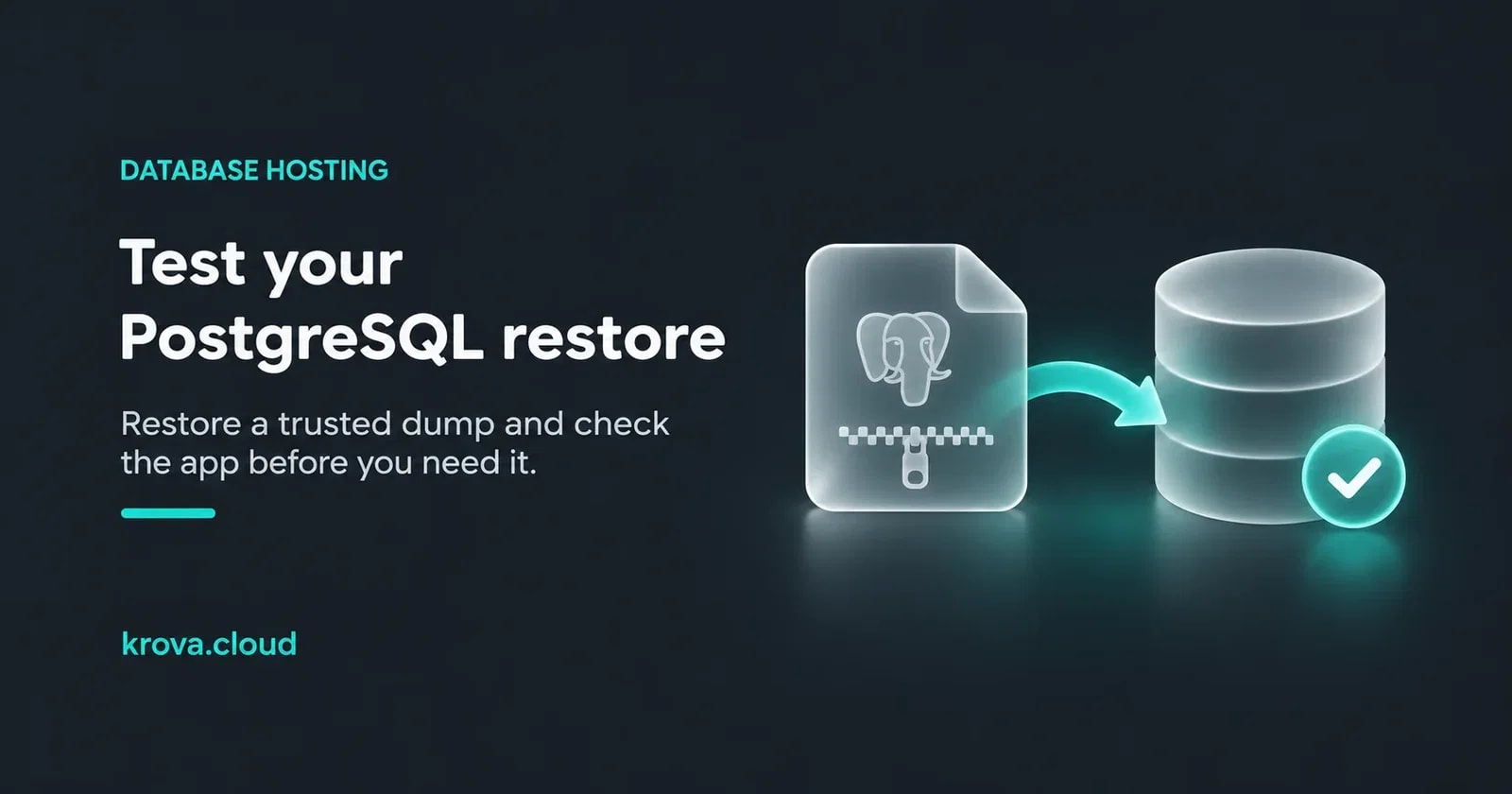
Imagine you're preparing a database maintenance window. The latest backup job is green, the archive is in storage, and the application is still running. There's one unanswered question: could you actually bring that application back using the file you've saved?
Test the restore on a separate PostgreSQL instance, then check the recovered data and the application's access to it. A readable archive and a successful restore command are useful milestones. Neither, on its own, proves that the application can resume the work you care about.
This walkthrough uses a clearly hypothetical maintenance scenario and illustrative PostgreSQL 18 commands. It is a proposed logical-restore drill, not a report of a customer incident or a test performed by the bylined author.
Decide what this rehearsal must prove
Start with the recovery question rather than a command. Are you checking that a recent dump can be loaded? That the production role can read the restored tables? Or that a whole service can recover within an agreed interruption window? Those require different evidence.
For a first drill, choose a trusted custom-format archive from your actual backup path and a disposable target running the same PostgreSQL major version. Record the source version, dump-tool version, archive identity, data horizon and destination. Don't use the object's upload time as a substitute for knowing which database state it contains.
PostgreSQL documents that pg_dump exports one database, with a consistent view even during concurrent use. It does not include cluster-wide objects such as roles. That makes a logical restore a useful bounded exercise, rather than proof that the entire server and its surroundings have been recovered. The same documentation cautions that, outside simple cases, pg_dump is generally not the right tool for regular production backups; choose a wider backup method for the workload.
For operators planning maintenance, the project's roadmap currently targets 12 November 2026 for the next minor releases. That is a reason to rehearse now, not a claim that an update has already shipped or that a dump is a complete rollback plan.
Make the destination unmistakably separate
Build the test database on a separate instance that cannot write to production. Restrict inbound access, protect the copied data, and disable outbound email, payment calls, webhooks and background jobs in any application copy. A restored database may contain real credentials or personal data; a test hostname doesn't remove that responsibility.
Restore only an archive from a source you trust. PostgreSQL warns that restoring can execute code chosen by the source's superusers. Isolation and reviewing an unfamiliar dump matter even when you restore only part of it.
The examples below assume a disposable PostgreSQL 18 server already exists at 127.0.0.1:55432, with a dedicated restore_admin role allowed to create a database. This is an example endpoint, not a Krova default. Verify where the socket or tunnel actually leads before running anything, and use test-only credentials.
# Confirm the intended disposable target before creating a database.
psql -X --host=127.0.0.1 --port=55432 \
  --username=restore_admin --dbname=postgres \
  --set=ON_ERROR_STOP=1 \
  --command='SELECT current_database(), current_user,
                    inet_server_addr(), inet_server_port(), version();'

# Stop if the destination is not the instance you intended.
Use the connection details together with your infrastructure inventory. An address or a version string alone is not an identity check. Keep passwords out of commands and logs; use your environment's supported protected credential mechanism.
Read the archive, then restore into an empty database
Retrieve the archive through the same storage and access path you would use during recovery. If your backup process supplies a trusted checksum, verify it. A local checksum can identify the file used in this drill, but cannot prove that the original backup captured the right data.
# Illustrative Bash commands; run each step only after the previous succeeds.
# app.dump must be your trusted custom-format archive.
pg_restore --version
pg_restore --list app.dump > archive-contents.txt

createdb --host=127.0.0.1 --port=55432 \
  --username=restore_admin --template=template0 \
  restore_drill_20261104

time pg_restore --host=127.0.0.1 --port=55432 \
  --username=restore_admin --dbname=restore_drill_20261104 \
  --exit-on-error --no-owner --no-privileges \
  app.dump
pg_restore reads non-plain archives produced by pg_dump. Its list mode shows archive contents; it is not a substitute for loading the data. --exit-on-error stops at a restore error. Because this example does not wrap the restore in one transaction, a failure can leave a partial test database: investigate it and begin a fresh rehearsal rather than calling that state recovered.
createdb's template option selects the source template for the empty database. Here, template0 avoids inheriting local additions from a customized default template. The example uses neither --clean nor --create; it targets the newly named drill database.
The ownership and privilege options are deliberate shortcuts for this first loading check. They leave ownership with the restoring role and skip restored access privileges. A pass with those options does not validate your production roles or grants. Plan a separate fidelity check with the required roles and permissions on an isolated target; pg_dumpall documents cluster-wide exports, which also need protected handling.
Ask the recovered database questions your app depends on
Return to the hypothetical maintenance window. Seeing the tables return is reassuring, but the useful next question is whether the recovered state supports the next real operation. Decide on checks before you run the drill, using expectations captured for the backup's data horizon.
A focused verification sheet might look like this. Replace the examples with checks for your own schema; there are no measured results in this table.
| Check | Evidence to collect | What it helps establish |
|---|---|---|
| Restore completed | Exit status, error log, archive identity | This archive loaded into this target |
| Expected data exists | Known record identifiers and relevant totals | The recovered state matches the chosen reference |
| Required extensions exist | Extension names and compatible versions | Database dependencies are present |
| App role works | Controlled reads and permitted test writes using that role | Authentication and grants support the workflow |
| Application reconnects | A restricted smoke test against this database only | Runtime configuration points to the recovered target |
| Sequences and constraints behave | A disposable transaction through the normal write path | Inserts and integrity checks behave as expected |
Compare against a baseline from the same recovery point. Counts from the live database taken much later can differ for perfectly valid reasons. Row counts are also too coarse to prove correctness alone: include records and invariants that matter to the application, without exporting sensitive values into the review log.
If optimizer statistics are missing or incomplete, refresh them as appropriate before judging query behavior. PostgreSQL's restore guidance discusses ANALYZE after recovery. A slow first query on a small test machine is not a benchmark for your production service.
Keep loading time separate from recovery time
Record how long it took to find the archive, retrieve it, prepare the target, restore, check permissions and reconnect the test application. The time command above measures only its restore process. Treating that number as the whole recovery duration would hide the steps that may take longest when the original operator isn't available.
Write down the limits alongside the result: one database, one archive, one target configuration, and the checks actually performed. This rehearsal doesn't validate point-in-time recovery, replication, failover, every extension or a larger workload automatically.
In particular, a logical dump is not a continuous recovery system. PostgreSQL's continuous archiving documentation describes base backups and write-ahead-log archives for point-in-time recovery. If losing changes since the dump would exceed your tolerance, test an appropriate recovery design instead of simply making this drill look successful.
Use a Cube for the rehearsal, with a clear boundary
A Krova Cube provides a Linux microVM with root access for a database environment you manage. That can be a separate target for this rehearsal. You still own PostgreSQL installation, compatible extensions, credential handling, data protection and application validation.
Krova snapshots and exports address machine-level recovery and portability. Keep that exercise distinct from restoring a PostgreSQL logical archive, and verify database consistency for the recovery method you actually use. This article does not assert that a running-machine snapshot proves application-level recovery.
If you're starting from the existing self-hosted PostgreSQL guide, make this the next task after arranging backups: choose one archive, restore it elsewhere, and save the evidence and the gaps. Then retire the temporary environment and sensitive copies under your retention policy.
Give your restore drill its own target
Explore Cube for a self-managed PostgreSQL test environment. Keep it separate from production and verify the application checks before relying on a recovery plan.
Creation context: AI-assisted technical guidance based on the linked primary sources, checked on 4 November 2026. The commands and checks are illustrative; no executed recovery results or personal testing by the bylined author are claimed.