PHP 8.6 trim(): Test Form Feeds at the Input Boundary
PHP 8.6 changes default trimming of boundary form feeds. Use a byte-visible fixture and application assertions to protect identifier normalization during an upgrade.
 DM
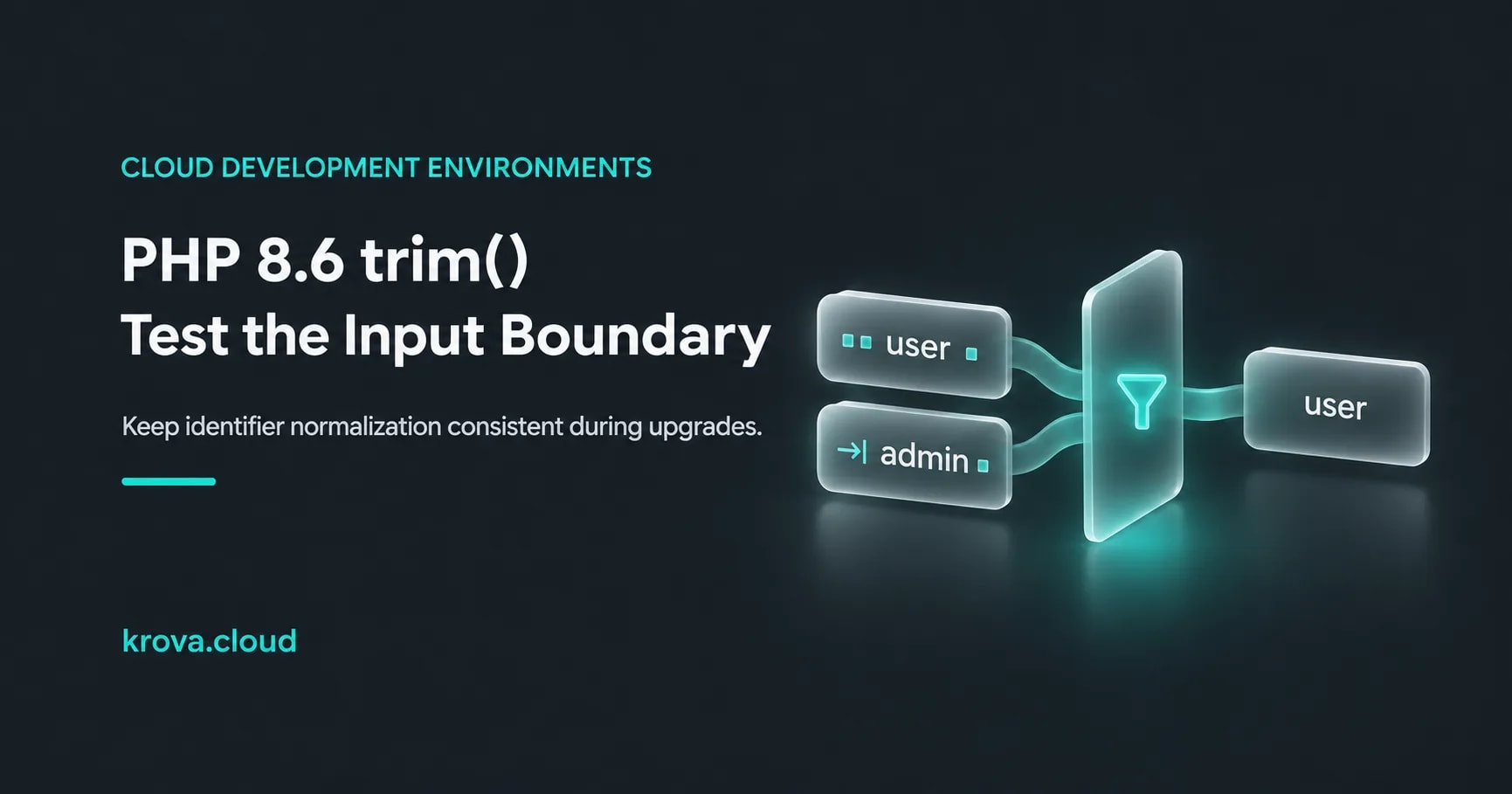
Imagine a nightly invoice importer on a self-managed Linux server. It trims a reference before looking up an invoice. The reference looks like INV-42 on screen, but the incoming value has a form-feed character at each end. After a runtime upgrade, that same line of application code can produce different identifier bytes.
For PHP 8.6, check boundary form feeds anywhere you rely on default trim(), ltrim() or rtrim(). The PHP 8.6 migration guide documents their addition to the default trimming characters. Decide whether your input contract should reject, remove or preserve those characters, then test that decision through the application's real input path.
PHP 8.6 was released on 19 November 2026. This is one compatibility check for an upgrade, not a reason to assume every PHP application is affected.
The invisible part is the useful part
A form feed is byte 0c in hexadecimal. PHP's trim documentation says the default character set includes it as of 8.6. Trimming works at string boundaries; it doesn't remove a form feed from the middle of a reference. An explicit second argument supplies a character list, which can also contain ranges.
In the hypothetical importer, the business question comes before the code change: is that boundary byte invalid input, harmless padding, or part of an identifier that must be preserved? If validation happens after trimming, a value previously rejected could become acceptable. If lookups use the trimmed value, a different record could be selected. Those are possible application consequences, not reported incidents; validation, stored data and database comparison rules determine what actually happens.
Make a four-case fixture visible
Use synthetic values in a disposable upgrade environment. This example prints the input and default-trimmed bytes, plus the runtime identity. bin2hex() makes bytes visible; it doesn't sanitize them. PHP_VERSION and PHP_SAPI identify the runtime executing this file.
<?php
$cases = [
    'space_edges' => "  INV-42  ",
    'form_feed_edges' => "\fINV-42\f",
    'form_feed_middle' => "INV\f42",
    'literal_backslash_f' => '\fINV-42\f',
];

printf("php=%s sapi=%s\n", PHP_VERSION, PHP_SAPI);
foreach ($cases as $name => $raw) {
    printf(
        "%s raw=%s trimmed=%s\n",
        $name,
        bin2hex($raw),
        bin2hex(trim($raw))
    );
}
The PHP string syntax reference explains why the last fixture matters: \f in a double-quoted string represents a form feed, while the single-quoted fixture contains literal backslash-and-letter text. A test containing only the latter won't exercise this change.
The following values are expected from the documented behavior, not captured test results. The example has not been executed for this article.
| Fixture | Expected trimmed hex on PHP 8.5 | Expected trimmed hex on PHP 8.6 |
|---|---|---|
| Spaces at both ends | 494e562d3432 | 494e562d3432 |
| Form feeds at both ends | 0c494e562d34320c | 494e562d3432 |
| Form feed in the middle | 494e560c3432 | 494e560c3432 |
| Literal backslash-f at both ends | 5c66494e562d34325c66 | 5c66494e562d34325c66 |
Run the file separately with your current runtime and the proposed 8.6 runtime. Keep both outputs. The useful upgrade question is whether the same input still reaches the same record, so this small comparison is the beginning of the check.
Choose a rule you can explain
If form feeds are forbidden in references, validate the raw input before a normalization step can erase the evidence. If your contract treats them as padding, deliberately remove them and test that behavior. If they are meaningful bytes, preserve them through a documented policy and make sure downstream systems agree.
For example, trim($raw, " \t\r\n") removes only the listed padding characters. That narrower mask is an illustration, not a universal fix: it also differs from PHP's default treatment of other characters. Use it only if those are exactly the characters your contract allows you to remove. A trimming rule is not a substitute for field validation.
Avoid a bulk rewrite of existing references just because the runtime changed. First characterize what is stored, how uniqueness is enforced, and whether two distinct raw inputs would become the same canonical value. Here, canonical means the application's agreed stored or comparison form, not a URL setting.
Test the importer, then the deployed path
Add fixtures to the real normalization and validation function. Assert three outcomes for each case: accepted or rejected, exact canonical bytes, and the record selected or duplicate decision produced. Include a previously stored reference and a deliberately conflicting input. Use test records so the exercise cannot change customer invoices.
For a command-line importer, run through the same launcher and configuration used by the job. For a web application, repeat the case through protected staging using the intended PHP worker. A successful command-line check establishes only what that process did; it doesn't establish the web worker's runtime or the entire request path.
If a systemd service launches the importer, Krova's guide to checking which systemd drop-ins actually loaded can help verify the launch configuration. Keep runtime diagnostics private, and record fixture labels and hex values rather than production payloads.
Leave with an explicit upgrade decision
The importer is ready for this particular change when its input policy is written down and its regression checks enforce that policy on the target runtime. If the byte comparison changes but the business assertions remain intentional, you've explained the difference. If the lookup or acceptance changes unexpectedly, resolve that before moving the workload.
Continue through the full PHP 8.6 migration guide for other compatibility changes. Passing this fixture doesn't establish extension compatibility, framework support or whole-application readiness.
Rehearse your PHP upgrade on Cube
Use self-managed Linux compute for a separate upgrade environment. Choose and manage the PHP runtime, application dependencies and input tests for your workload.
Creation context: this AI-assisted article uses PHP's primary documentation. The invoice importer is hypothetical; the code and expected outputs are illustrative and have not been tested by the bylined author for this article.