Ephemeral Infrastructure: Why Throwaway Is Winning
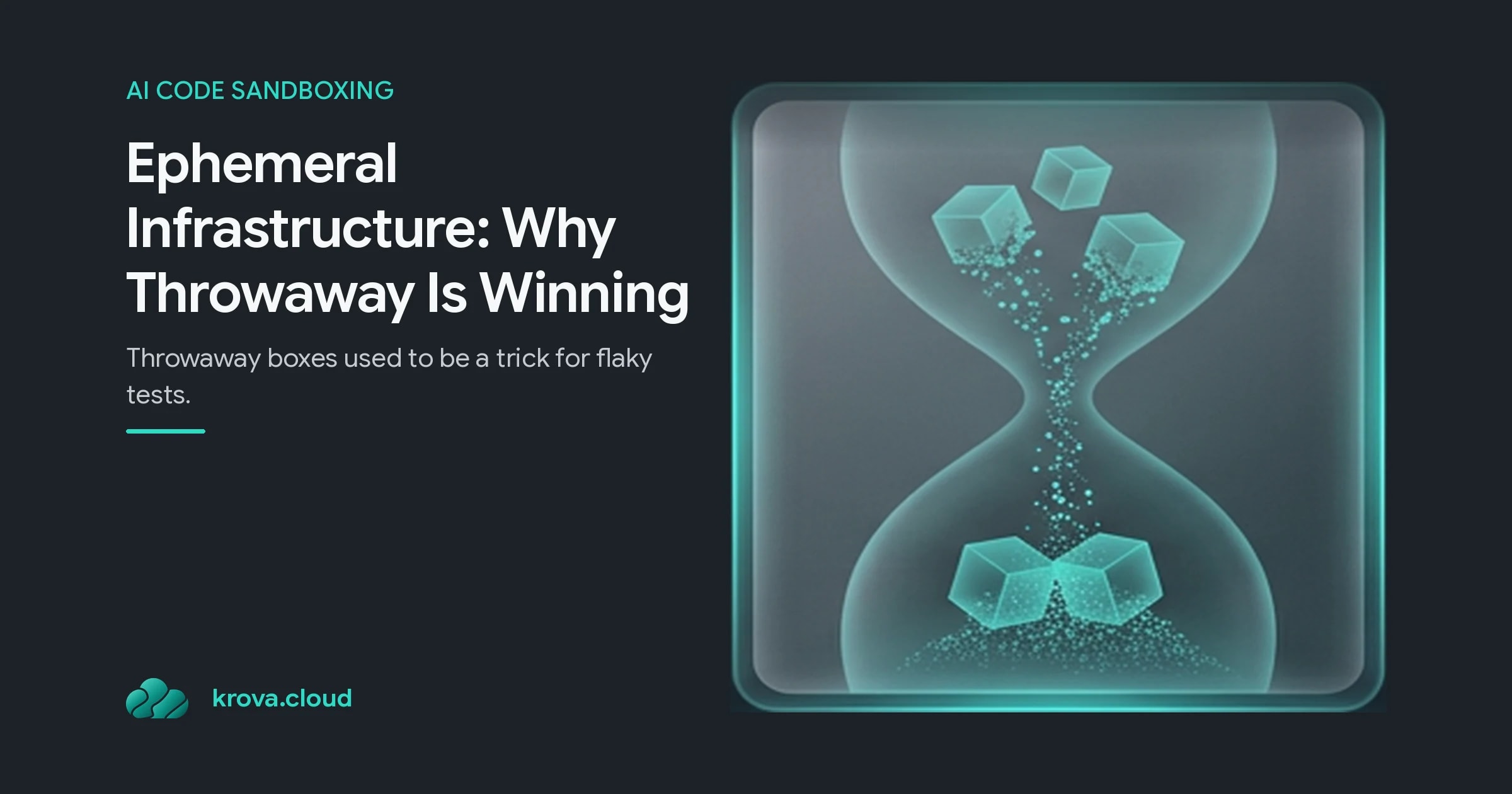
Throwaway boxes used to be a trick for flaky tests. In 2026 agents, evals and CI all assume infrastructure that dies. Here is what changed and why.
Ephemeral Infrastructure: Why Throwaway Is Winning
Ephemeral infrastructure stopped being a workaround this year. It became the default shape for anything that runs code on behalf of a person or a model. The signal is not one announcement; it is the market structure. When we counted the fifteen sandbox providers listed, according to Upstash's October 2026 comparison, every single one billed per second or per minute, and most advertised sleep states as a feature.
Pricing follows demand, and demand now assumes boxes that die. We tracked the same signal in plan pages: sleep states moved from footnote to headline feature across three vendors during 2026 alone. Marketing copy is a lagging indicator, which is what makes it trustworthy here.
What changed in 2026
Three forces converged. Coding agents turned compute into a per-task consumable, with loops that live minutes and vanish. Evaluation harnesses industrialised that pattern into thousands of parallel short-lived rollouts, as Fly's own RL pricing guide models. And CI moved from shared runners to per-job isolation, because supply-chain attacks made shared caches a liability. None of these workloads wants a server; they want a box with a birth and a death.
Why the economics finally work
Throwaway computing was always architecturally nice and economically awkward: provisioning a VM per task cost more than the task. MicroVM boot times in the low hundreds of milliseconds, snapshot restore, and per-second meters inverted that. Fly's learn pages now price idle at zero for sleeping Sprites; E2B pauses sandboxes and stops the meter; Modal bills use. The unit cost of a birth-and-death cycle fell below the unit cost of keeping something alive.
What ephemeral-first changes for architects
- State moves out of the box: into object storage, databases and snapshots, because the box is mortal by design.
- Identity moves out too: short-lived credentials injected at create time replace baked-in secrets.
- Failure handling simplifies: a sick environment is destroyed and reborn, not debugged at 2am.
- Cost models shift from capacity to throughput, which we unpack in why teams need ephemeral environments now.
The pattern shows up identically in on-demand developer environments and in cloud development environment roundups: the environment is cattle so extreme that it never gets a name.
The counter-pressure
Ephemeral-first is not free. Cold starts tax latency-sensitive interactive work, snapshot storage costs real money, and debuggability suffers when evidence dies with the box. Teams answer with logging shipped out in real time and with warm pools for hot paths. We saw both patterns in vendor docs this week; neither is settled practice yet.
A checklist for going ephemeral-first
Start new code-execution workloads with four defaults: state outside the box, credentials injected at create time, logs shipped in real time, and a hard TTL with automated teardown. Anything that fights those defaults gets an explicit design note.
Existing long-lived services earn a migration ticket only when their blast radius or cost curve justifies it. Ephemeral-first is a direction of travel, not a rewrite mandate, and teams that treat it as dogma ship outages instead of savings.
Verdict
Design new code-execution workloads as ephemeral-first, and treat long-lived servers as the special case that needs justification. The billing models, the isolation technology and the tooling all moved that way in 2026, and fighting the current now costs both money and speed.
Limitations
- Our provider count comes from one October 2026 comparison; however, other lists differ in membership.
- Sleep-state and pause semantics vary, so "idle is free" is true per provider, but not universally.
- We cite vendor pricing pages and learn articles; rates cannot stay current for more than months.
- Debuggability tradeoffs are our engineering judgement, not measured data.
FAQ
Does ephemeral-first mean stateless applications?
No. It means state lives outside the compute box, in storage and databases that outlive it. The box stays disposable.
Is this just containers with extra steps?
The idea predates containers, but microVMs made per-task isolation cheap enough to apply everywhere, not only to trusted code.
When should we keep a long-lived server?
For latency-critical interactive sessions and for stateful services with heavy warm-up. Everything else can probably die.
{
  "@context": "https://schema.org",
  "@graph": [
    {
      "@type": "BlogPosting",
      "headline": "Ephemeral Infrastructure: Why Throwaway Is Winning",
      "datePublished": "2026-10-24",
      "dateModified": "2026-10-24",
      "author": {"@type": "Organization", "name": "Krova Cloud Engineering"},
      "publisher": {"@type": "Organization", "name": "Krova Cloud"},
      "mainEntityOfPage": "https://krova.cloud/blog/ephemeral-infrastructure-throwaway-computing-trend"
    },
    {
      "@type": "FAQPage",
      "mainEntity": [
        {
          "@type": "Question",
          "name": "Does ephemeral-first mean stateless applications?",
          "acceptedAnswer": {"@type": "Answer", "text": "No. It means state lives outside the compute box, in storage and databases that outlive it. The box stays disposable."}
        },
        {
          "@type": "Question",
          "name": "Is this just containers with extra steps?",
          "acceptedAnswer": {"@type": "Answer", "text": "The idea predates containers, but microVMs made per-task isolation cheap enough to apply everywhere, not only to trusted code."}
        },
        {
          "@type": "Question",
          "name": "When should we keep a long-lived server?",
          "acceptedAnswer": {"@type": "Answer", "text": "For latency-critical interactive sessions and for stateful services with heavy warm-up. Everything else can probably die."}
        }
      ]
    }
  ]
}